
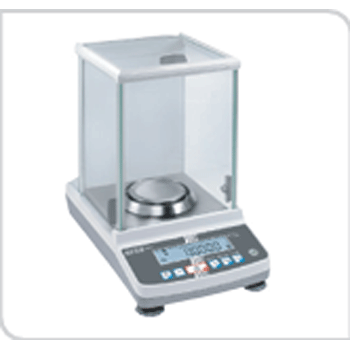
analytical balance is a highly sensitive and precise laboratory instrument used to accurately measure the mass of small samples, typically in the sub-milligram range (down to 0.00001 grams or 0.01 mg). They are essential for applications requiring extremely accurate and reproducible measurements.
High Precision and Accuracy: Analytical balances are designed for exceptional precision, often reading to four or even five decimal places of a gram. This level of accuracy is crucial in sensitive applications.
Readability: This refers to the smallest increment of weight the balance can display. For analytical balances, readability typically ranges from 0.1 mg to 0.01 mg or even 0.001 mg (microgram) for ultra-microbalances.
Draft Shield/Weighing Chamber: A transparent enclosure (usually glass) with doors surrounds the weighing pan. This draft shield protects the delicate weighing mechanism and the sample from external influences like air currents, dust, and temperature fluctuations, which can significantly affect such sensitive measurements.
Leveling Mechanism: Analytical balances are extremely sensitive to their environment. They are equipped with a spirit level and adjustable feet to ensure the balance is perfectly level, as even a slight tilt can impact accuracy.
Calibration: Regular calibration with certified reference weights is critical to maintain accuracy and ensure reliable results. Many modern analytical balances have internal or external calibration features.
Working Principle (Magnetic Force Restoration): Most analytical balances operate on the principle of magnetic force restoration. When a sample is placed on the weighing pan, an electromagnetic force is generated to counterbalance its weight. The electrical current required to generate this force is directly proportional to the mass of the object, which is then displayed as the weight reading. This differs from older mechanical balances that relied on a lever system.
Tare Function: This allows the user to zero out the weight of a container, so only the mass of the sample is measured.
Sensitivity to Environmental Factors: Due to their high sensitivity, analytical balances are highly susceptible to environmental changes. Factors like temperature, humidity, vibrations, and static electricity can cause "drift" (unstable readings) or inaccurate results. Proper installation in a stable, controlled environment is paramount.
Applications:
Analytical balances are indispensable in various scientific, industrial, and research settings where precise mass measurements are required. Common applications include:
Chemical Analysis and Research: Measuring reagents, samples, and reaction products in quantitative analysis, gravimetric analysis, and concentration determinations.
Pharmaceutical and Biotechnology Industries: Essential for drug development, quality control of active pharmaceutical ingredients, formulation, and preparation of solutions.
Material Science and Engineering: Measuring and analyzing small quantities of materials like polymers, metals, and nanoparticles.
Quality Control: Ensuring products meet specific standards and regulations in various industries (food, cosmetics, manufacturing).
Environmental Testing: Measuring pollutants, contaminants, and other substances in air, water, and soil samples.
Forensic Science: Analyzing trace evidence like fibers, hair, or powders.
Calibration and Metrology: Used to validate the performance of other weighing instruments and maintain traceability to international standards.
Academic Research: Measuring samples for studies in chemistry, biology, physics, and other scientific disciplines.
In summary, an analytical balance is a sophisticated and indispensable tool for any laboratory or industry demanding exceptionally accurate and precise mass determination of small samples.
 Atomic Absorption Spectrophotometer
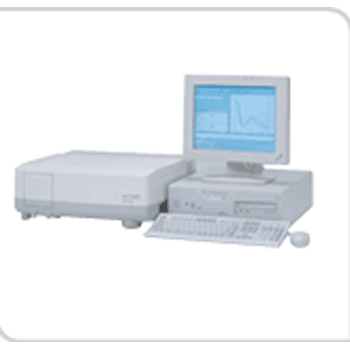 UV Vis Spectrophotometer
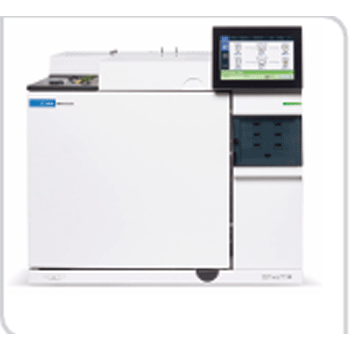 Gas Chramatograp (GC)
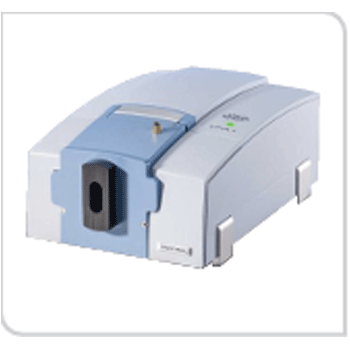 FT-IR Spectrometer
 CHNS Analyzer
 Simultaneous Thermal Analysis (TGA DTA)