
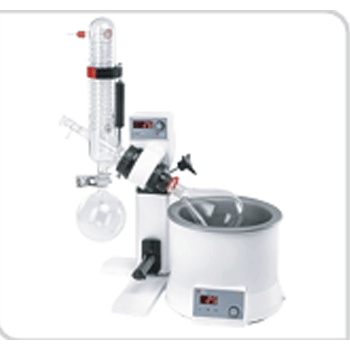
The core principle behind a digital rotary evaporator, like its manual counterpart, is reduced pressure distillation. It leverages the fact that lowering the pressure above a liquid significantly reduces its boiling point. This allows solvents to evaporate at much lower temperatures than they would at atmospheric pressure, which is crucial for handling heat-sensitive compounds without degradation.
Sample Placement: The liquid mixture containing the desired compound and the solvent is placed in a round-bottom flask.
Rotation: The flask is connected to a motor that rotates it at a controlled speed.
Heating: The rotating flask is immersed in a heated fluid bath (usually water or oil).
Vacuum Application: A vacuum pump is connected to the system, which reduces the pressure inside the entire apparatus. This lowered pressure causes the solvent to boil and evaporate at a significantly reduced temperature.
Condensation: The evaporated solvent vapor then travels through a vapor duct to a condenser.
Key Features of Digital Rotary Evaporators:
The "digital" aspect brings significant advantages:
Precise Digital Control:
Rotation Speed: Digital display and precise control over the rotation speed (e.g., 20-280 rpm) allow for optimization based on the sample's viscosity and desired evaporation rate.
Heating Bath Temperature: Digital display and accurate temperature control (
Vacuum Control: Many advanced digital models integrate a vacuum controller for precise management of the vacuum level, further enhancing control over the evaporation process.
Safety Features:
Automatic Motor Lift: In case of power failure, the evaporating flask is automatically lifted out of the heating bath to prevent superheating or "bumping" of the solvent.
Overheating Protection: Safety temperature circuits can be set to prevent the bath from exceeding a specific temperature (e.g.,
Dry-Run Protection: Prevents the heating bath from operating without liquid.
Adjustable Lower End Stop: Protects glassware from breaking.
Lock Function: Prevents accidental changes to bath settings.
Coated Glassware (Optional): Provides added safety against breakage and chemical resistance.
Enhanced User Experience:
LCD/Color Graphic Display: Clear display of speed, temperature, time, and other parameters.
Intuitive Interface: Easy navigation and operation through user-friendly menus.
Timer Function: Allows for automated operation for a set duration.
Ergonomic Design: Handles on the heating bath, push-off mechanisms for easy flask removal, and overall design for comfortable and safe handling.
Connectivity:
RS-232/USB Interface: Enables remote control via PC software (e.g., "labworldsoft") and data transmission for monitoring and logging.
Efficiency:
Optimized Bath Volume: Allows for faster heat-up times.
Highly Efficient Condenser: Large cooling surface area (e.g., 1500 cm2) for effective condensation.
Patented Sealing Ring (e.g., PTFE): Provides excellent sealing performance for maintaining vacuum.
Uses of Digital Rotary Evaporators:
Digital rotary evaporators are indispensable in a wide range of scientific and industrial applications due to their precision and efficiency:
Solvent Removal and Concentration: The primary use in chemical, pharmaceutical, and biological laboratories to remove volatile solvents from liquid mixtures, leaving behind a concentrated sample.
Sample Preparation: Essential for preparing samples for further analysis by techniques like chromatography or spectroscopy, ensuring accurate results.
Compound Purification: Used to purify compounds by separating them from reaction by-products or impurities.
Extraction of Essential Oils: Employed in the food, cosmetic, and fragrance industries to extract essential oils from plants and herbs.
Pharmaceutical Industry: Crucial for crystallization, drying, separation, and solvent recovery in drug development and the purification of active pharmaceutical ingredients (APIs).
Food Processing: Used for concentrating fruit juices, removing solvents from food extracts, and other processes requiring sterile environments.
Recycling of Solvents: Facilitates the recovery and reuse of solvents, reducing waste and operating costs.
Heat-Sensitive Procedures: Ideal for processes involving heat-sensitive compounds due to the ability to evaporate at lower temperatures under vacuum.
Research and Development: Widely used in academia and industrial research for developing new materials, natural product isolation, and organic synthesis.
In summary, a digital rotary evaporator combines the fundamental principles of rotary evaporation with advanced digital control and safety features, making it an indispensable, precise, and efficient tool in modern laboratories across various disciplines.
 Atomic Absorption Spectrophotometer
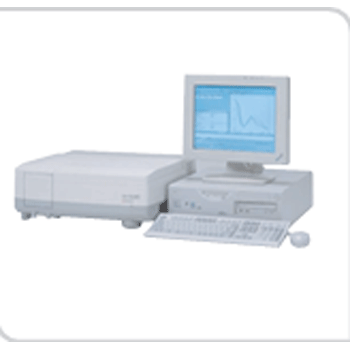 UV Vis Spectrophotometer
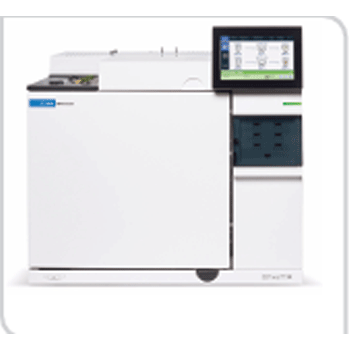 Gas Chramatograp (GC)
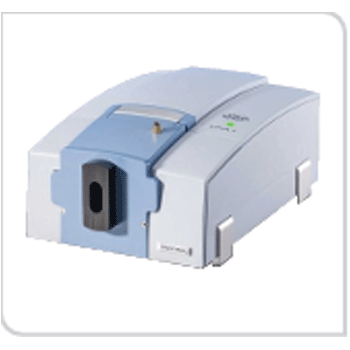 FT-IR Spectrometer
 CHNS Analyzer
 Simultaneous Thermal Analysis (TGA DTA)