
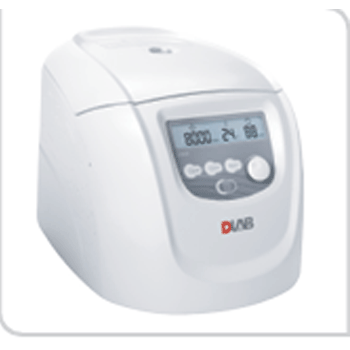
A High-Speed Micro Centrifuge is a crucial piece of laboratory equipment designed for the rapid and efficient separation of small-volume samples. It utilizes centrifugal force to separate components of a mixture based on their density, making it indispensable in various scientific fields.
A High-Speed Micro Centrifuge is a crucial piece of laboratory equipment designed for the rapid and efficient separation of small-volume samples.
Here's a detailed description:
Core Principle:
The fundamental principle behind a high-speed micro centrifuge is centrifugation.
High Speed and RCF: These centrifuges can achieve speeds ranging from 10,000 RPM up to 15,000 RPM or even higher, generating powerful RCFs (often exceeding 15,000 x g, sometimes even over 20,000 x g). This high force allows for fast and effective separation of various biological and chemical components.
Compact Design: High-speed micro centrifuges are typically benchtop units with a small footprint, making them suitable for laboratories with limited space.
Brushless DC Motor: Most modern high-speed micro centrifuges are equipped with maintenance-free brushless DC motors, ensuring quiet operation, long lifespan, and precise speed control.
Programmable Operation: They often feature intuitive controls, usually with a large LED or LCD display, allowing users to easily set parameters like speed (RPM or RCF), time, and acceleration/deceleration rates.
Safety Features: Given the high speeds, safety is paramount. Common safety features include:
Motor-driven lid locking system/Door interlock: Prevents opening the lid during operation.
Over-speed detection: Shuts down the unit if the speed exceeds the set limit.
Over-temperature detection: Protects sensitive samples and the instrument from overheating.
Rotor imbalance detection: Automatically stops the centrifuge if the rotor is unbalanced, preventing damage and ensuring user safety.
Automatic self-diagnostics: Helps identify and troubleshoot issues.
Explosion-proof design: Some models incorporate features to minimize risk in case of tube breakage.
Rotor Options: High-speed micro centrifuges typically come with an aluminum alloy rotor, often with a biosafety containment lid, that can accommodate various microcentrifuge tube sizes (e.g., 0.2 mL, 0.5 mL, 1.5 mL, 2.0 mL), and sometimes PCR strips or even 5 mL tubes with adapters.
Temperature Control (Refrigerated Models): Some advanced high-speed micro centrifuges are refrigerated, allowing them to maintain a precise temperature (often ranging from -20°C to 40°C) during operation.
PULSE" or "Short-Spin" Function: This feature allows for quick, brief spins, ideal for collecting droplets from the tube lid or for rapid mixing.
Fast Acceleration and Braking: Efficient acceleration and deceleration times reduce overall processing time.
Low Noise Level: Designed for quiet operation to maintain a comfortable lab environment.
Typical Applications: High-speed micro centrifuges are versatile tools with wide-ranging applications in various scientific disciplines, including:
Molecular Biology: DNA and RNA extraction and purification Plasmid preparation PCR amplification cleanup Nucleic acid precipitation
Biochemistry and Protein Research: Protein precipitation and purification Separation of subcellular organelles Enzyme assays
Clinical Diagnostics: Separation of serum or plasma from whole blood Urine sediment analysis Isolation of specific cell types for cytological examination
Cell Biology: Cell harvesting and separation Cell fractionation Separation of different cell types and components
Microbiology and Virology: Concentration and purification of microorganisms, viruses, and viral particles Study of microbial growth
Research and Development: Sample preparation for various analytical techniques Drug discovery and development (e.g., high-throughput screening)
Food Science and Environmental Studies: Analysis of food composition Detection of contaminants Soil and water analysis In summary, a high-speed micro centrifuge is an essential and ubiquitous instrument in modern laboratories, providing precise, efficient, and safe separation of small-volume samples for a multitude of research, diagnostic, and industrial applications.
 Atomic Absorption Spectrophotometer
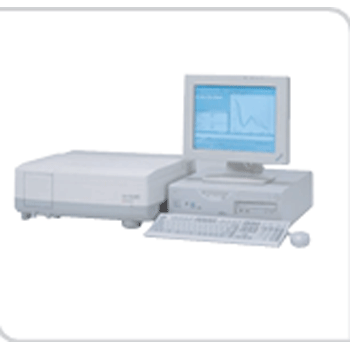 UV Vis Spectrophotometer
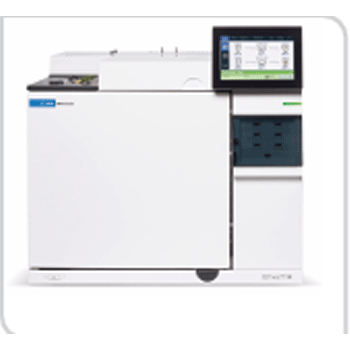 Gas Chramatograp (GC)
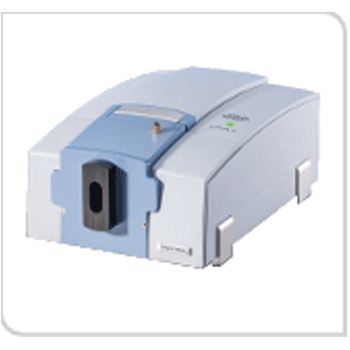 FT-IR Spectrometer
 CHNS Analyzer
 Simultaneous Thermal Analysis (TGA DTA)