
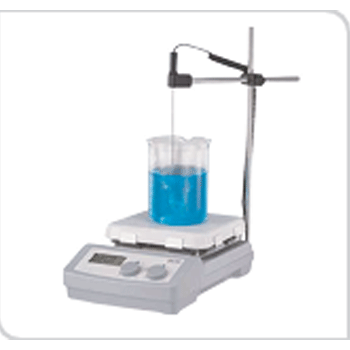
A Digital Hot Plate Magnetic Stirrer is a versatile laboratory instrument that combines the functions of heating and stirring solutions. It is widely used in various scientific fields such as chemistry, biology, materials science, and pharmaceuticals for tasks like preparing solutions, performing titrations, chemical synthesis, and culturing microorganisms.
A Digital Hot Plate Magnetic Stirrer is a versatile laboratory instrument that combines the functions of heating and stirring solutions.
Core Functionality:
Heating: The "hot plate" component provides a precisely controlled heated surface.
Magnetic Stirring: The "magnetic stirrer" component uses a rotating magnetic field to cause a small, inert stir bar (often coated in Teflon or glass) immersed in the liquid to spin.
Digital Advantages:
The "digital" aspect signifies advanced control and monitoring capabilities, offering significant improvements over older analog models:
Precise Temperature Control: Digital hot plate stirrers allow for highly accurate temperature settings and often include PID (Proportional-Integral-Derivative) auto-tuning for optimal temperature stability.
Digital Display: They feature clear LED or LCD displays that show real-time readings of both temperature (in degrees Celsius, often up to 300°C, 350°C, or even 400°C+) and stirring speed (in revolutions per minute, RPM, typically ranging from 100 to 1500+ RPM).
Accurate Speed Control: Digital controls enable precise adjustment of stirring speed, often with resolutions of ±1 RPM, ensuring consistent mixing.
External Temperature Probe (Optional/Included): Many digital models come with or can be connected to an external temperature sensor (e.g., PT1000).
Timer Function: Many units include a built-in timer (e.g., up to 99 hours 59 minutes), enabling unattended operation and ensuring experiments run for a specified duration.
programmable Settings: Some advanced digital stirrers allow users to store multiple programs with different speed, temperature, and duration settings for various experimental protocols.
Safety Features: Digital models often incorporate enhanced safety features, such as:
Hot Warning Indicator: An LED or display message (e.g., "HOT") that indicates when the hot plate surface is above a certain temperature (e.g., 50°C), even after heating has been turned off, to prevent accidental burns.
Overheating Protection: Automatic shut-off mechanisms if the temperature exceeds a safe limit.
Smooth Acceleration: Gradual increase in stirring speed to prevent splashing of hot or hazardous liquids.
Enclosed Heating Plate Design: Reduces the risk of liquid splashing into the internal components.
Construction and Design:
Work Plate Material: Commonly made from stainless steel with a ceramic coating or aluminum.
Ceramic-coated plates offer excellent chemical resistance, thermal-shock capability, and are easy to clean.
Aluminum plates provide fast and even heat distribution.
Casing: Often made from durable materials like ABS plastic with fire-retardant properties, resistant to weak acids and alkalis, or powder-coated cast-aluminum.
Compact Design: Many units are designed to be space-efficient, making them ideal for crowded lab benches.
Sturdy Base: Ensures stability during operation.
Applications:
Chemical synthesis and reactions
Solution preparation (dissolving solids, diluting reagents)
Titrations (acid-base, potentiometric)
Media preparation in microbiology
Sample analysis in various fields (e.g., environmental, pharmaceutical, food)
Experiments requiring controlled heating and mixing
In essence, a digital hot plate magnetic stirrer provides a reliable, precise, and safe method for heating and mixing solutions in a laboratory setting, offering superior control and reproducibility compared to their analog counterparts.
 Atomic Absorption Spectrophotometer
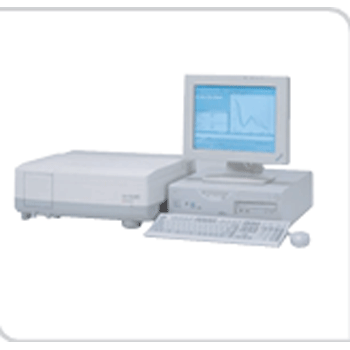 UV Vis Spectrophotometer
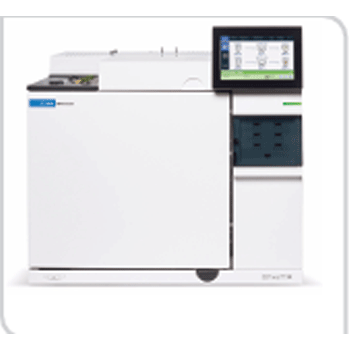 Gas Chramatograp (GC)
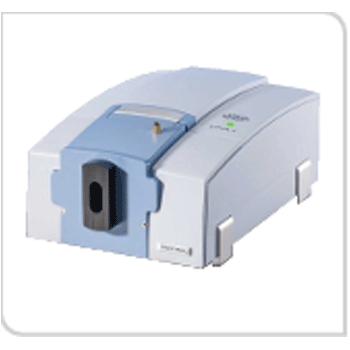 FT-IR Spectrometer
 CHNS Analyzer
 Simultaneous Thermal Analysis (TGA DTA)