
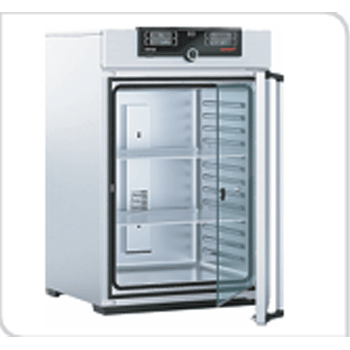
The primary purpose of a humidity chamber is to simulate real-world environmental stresses, particularly those related to moisture, to assess the durability, reliability, and performance of products before they are released to the market. This helps manufacturers identify potential failure points, enhance designs, and select more robust materials.
Pharmaceutical Industry: For stability testing of drugs, medications, and vaccines to determine shelf life and ensure their efficacy and safety under various storage conditions (e.g., according to ICH guidelines like 25°C/60% RH or 40°C/75% RH).
Electronics Industry: To test circuit boards, electronic components, and devices for their resistance to corrosion, short-circuiting, and material swelling in humid conditions.
Automotive Industry: To evaluate the durability and performance of car parts (e.g., dashboards, seats, engine components) under humid and varying temperature conditions to prevent cracking, fading, or failure.
Food and Beverage Industry: To assess the shelf life and quality of products and packaging materials in humid environments, preventing spoilage and ensuring product integrity.
Textile Industry: To test fabrics for colorfastness, mold growth, and changes in physical properties when exposed to elevated temperatures and humidity.
Construction Industry: To evaluate the durability of building materials like cement, wood, and paint against moisture and climatic stresses.
Biomedical Research: For studying the effects of humidity on biological samples, cell cultures, seeds, and tissues to understand their behavior in different environments.
Material Testing: To determine the response of various materials (polymers, metals, adhesives, etc.) to moisture, evaluating factors like adhesive strength, corrosion resistance, and physical degradation.
Research and Development: To simulate specific climate conditions for a wide range of experiments and studies, including plant growth, bacteria, and chemical reactions.
Working Principle:
A humidity chamber operates on the principle of precisely controlling moisture and temperature within an enclosed, insulated space. Key components and their functions include:
Chamber Structure: Typically made of stainless steel, it's a sealed, insulated enclosure to prevent external environmental interference.
Humidification System: Introduces moisture into the chamber. Common methods include:
Steam Generators: Boil water to create steam, which is then injected into the chamber.
Ultrasonic Humidifiers: Generate a fine mist of water droplets.
Water Spray Systems: Release fine water mists.
Dehumidification System: Removes excess moisture when humidity levels need to be reduced. This can involve:
Cooling Coils: Air is cooled, causing moisture to condense and drain out.
Desiccants: Drying agents (like silica gel) absorb moisture from the air.
Temperature Control System: Regulates the internal temperature using:
Heating Elements: To raise the temperature.
Cooling Units (Refrigeration System): To lower the temperature. Many chambers use CFC-free compressors.
Air Circulation System: Fans or blowers ensure uniform distribution of both temperature and humidity throughout the chamber, preventing hot or cold spots and ensuring consistent conditions for all test samples.
Monitoring and Control Unit: Sophisticated digital controllers (often PID or PLC-based with touchscreens) and sensors continuously monitor real-time temperature and humidity levels. This data is fed back to the control unit, which automatically adjusts the humidification, dehumidification, heating, and cooling systems to maintain the preset parameters. Many systems also offer data logging, alarms, and remote monitoring capabilities.
Features and Specifications (Typical):
Construction: Double-walled, insulated chamber, typically with an interior of stainless steel (SS304 or SS316) and an exterior of powder-coated GI sheet or stainless steel.
Temperature Range: Varies widely depending on the model, from basic ambient to -70°C up to +180°C.
Humidity Range: Typically 10% RH to 98% RH (Relative Humidity), with active control.
Accuracy: High precision in maintaining set points, e.g., ±0.2∘C for temperature and ±2.0% RH for humidity.
Uniformity: Ensures consistent conditions throughout the chamber, e.g., ±2.0∘C for temperature and ±3.0% RH for humidity.
Control System: Microprocessor-based PID controllers or advanced PLC-based HMI (Human Machine Interface) with color touch screens, data logging, and programmable test profiles.
Safety Features: Over-temperature protection, over-current protection, low water safety devices, alarms, and emergency stop functions.
Viewing: Multi-pane viewing doors (often heated to prevent condensation) for observing samples without disturbing the internal environment.
Shelving: Adjustable, perforated stainless steel trays for optimal airflow and sample placement.
Optional Features: Stand-by humidity/refrigeration systems, integrated lighting (for photostability testing), validation ports, caster wheels, and compliance with industry standards (e.g., 21 CFR Part 11 for pharmaceuticals).
Sizes: Available in various capacities, from benchtop models (e.g., 50 liters) to reach-in chambers (hundreds of liters) and large walk-in chambers (thousands of liters) for testing large items or numerous samples.
In essence, a humidity chamber is an indispensable tool for quality assurance, research, and development across diverse industries, enabling precise control over environmental variables to ensure product reliability and performance.
 Atomic Absorption Spectrophotometer
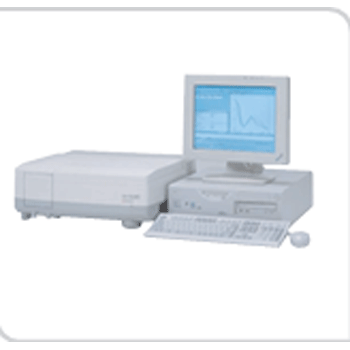 UV Vis Spectrophotometer
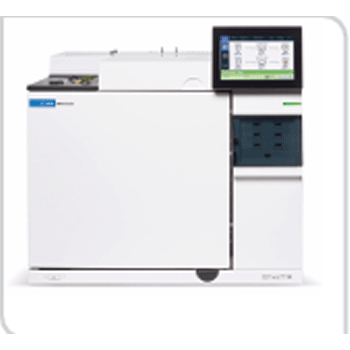 Gas Chramatograp (GC)
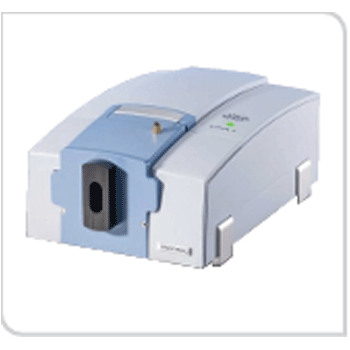 FT-IR Spectrometer
 CHNS Analyzer
 Simultaneous Thermal Analysis (TGA DTA)