
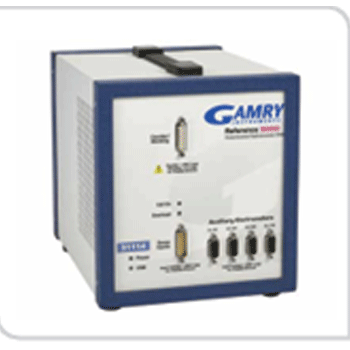
Potentiostatic Mode (Constant Potential): In this mode, the potentiostat maintains a constant voltage (potential) between two specific electrodes in the electrochemical cell (the working electrode and the reference electrode) while measuring the resulting current that flows through the cell. This is particularly useful for studying reactions where the potential is the driving force, such as corrosion studies, analytical electrochemistry, and understanding reaction mechanisms. Galvanostatic Mode (Constant Current): In this mode, the galvanostat controls and maintains a constant current flowing through the electrochemical cell, while measuring the resulting voltage (potential) response. This mode is crucial for applications like battery research (charging/discharging cycles), electrodeposition, and electrolysis, where a specific current input is required.
Potentiostatic Mode (Constant Potential): In this mode, the potentiostat maintains a constant voltage (potential) between two specific electrodes in the electrochemical cell (the working electrode and the reference electrode) while measuring the resulting current that flows through the cell.
Galvanostatic Mode (Constant Current): In this mode, the galvanostat controls and maintains a constant current flowing through the electrochemical cell, while measuring the resulting voltage (potential) response.
Many modern instruments can seamlessly switch between these two modes to accommodate complex experimental protocols.
To achieve precise control and measurement, potentiostats/galvanostats typically employ a three-electrode system within the electrochemical cell:
Working Electrode (WE): This is the electrode where the electrochemical reaction of interest takes place.
Reference Electrode (RE): This electrode provides a stable and known potential against which the potential of the working electrode is measured and controlled.
Counter Electrode (CE) or Auxiliary Electrode: This electrode completes the electrical circuit, allowing current to flow to or from the working electrode.
At its core, a potentiostat uses a negative feedback mechanism involving operational amplifiers (op-amps).
Potentiostatic Mode: The instrument compares the desired potential (set by the user) with the actual potential measured between the working and reference electrodes. Any difference (error signal) is then amplified and used to adjust the current flowing through the counter electrode. This adjustment forces the working electrode's potential to match the set potential, effectively "holding" it constant.
Galvanostatic Mode: Similarly, in galvanostatic mode, the instrument monitors the actual current flowing through the cell and compares it to the desired constant current. It then adjusts the potential applied to the cell (via the counter electrode) to maintain the set current. The resulting potential across the cell is then measured.
Signal Generator: Creates the desired voltage or current waveform (e.g., a constant voltage, a voltage sweep for cyclic voltammetry, or a constant current pulse).
Control Amplifier: This is a high-gain operational amplifier that takes the error signal (difference between desired and actual potential/current) and outputs the necessary voltage/current to the counter electrode to maintain the controlled parameter.
Electrometer (Voltage Follower): Measures the potential difference between the working and reference electrodes with very high impedance, ensuring no current flows through the reference electrode, thus preserving its stable potential.
Current-to-Voltage Converter (I/E Converter): Measures the current flowing between the working and counter electrodes by converting it into a measurable voltage drop across a precision resistor.
 Atomic Absorption Spectrophotometer
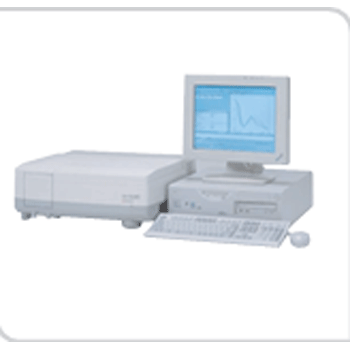 UV Vis Spectrophotometer
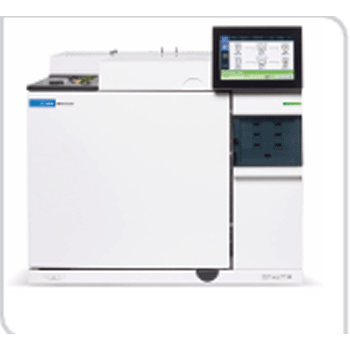 Gas Chramatograp (GC)
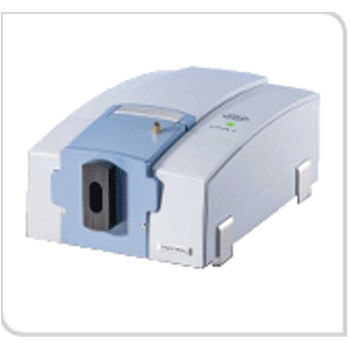 FT-IR Spectrometer
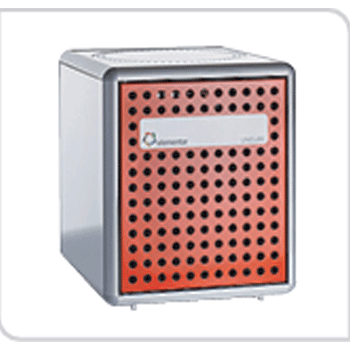 CHNS Analyzer
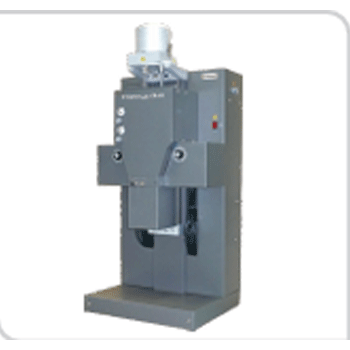 Simultaneous Thermal Analysis (TGA DTA)