
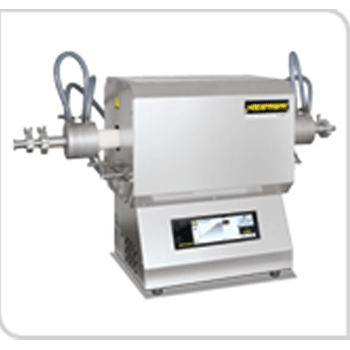
A tube furnace is an electric heating device widely used in laboratories and industrial settings for various high-temperature applications. Its defining characteristic is a cylindrical heating chamber, often made from ceramic, quartz, or metal, where samples are placed for processing.
A tube furnace is an electric heating device widely used in laboratories and industrial settings for various high-temperature applications.
Here's a detailed description of a tube furnace:
1. Basic Design and Components:
Cylindrical Chamber (Work Tube): This is the core component where the sample is heated.
Heating Elements: These coils or rods surround the cylindrical work tube and generate heat.
Thermal Insulation: Surrounding the heating elements and cylindrical cavity is a thermally insulating matrix.
Temperature Control System: Tube furnaces are equipped with precise temperature control systems.
Exterior Structure: The outer casing of the furnace is made from robust, heat-resistant materials to ensure durability and safety during high-temperature operations.
2. Key Features and Advantages:
Precise Temperature Control: The design of tube furnaces allows for highly accurate and stable temperature control, which is critical for many sensitive applications.
Uniform Temperature Distribution: The cylindrical shape and strategic placement of heating elements ensure a consistent temperature profile along the length of the tube, providing excellent thermal uniformity for the samples.
Controlled Atmosphere Capabilities: Many tube furnaces can be operated under various atmospheres (inert, reactive, vacuum) by using gas purging systems, vacuum pumps, and specialized flanges.
Versatility: Tube furnaces are highly versatile and can be configured for horizontal or vertical operation, with different tube diameters and lengths to accommodate various sample sizes and quantities.
Rapid Heat-Up and Cool-Down: Due to their relatively smaller volume capacity compared to chamber furnaces, tube furnaces often offer faster heat-up and cool-down rates.
Safety Features: Modern tube furnaces typically include safety features such as over-temperature protection, insulation plugs, and radiation shields.
3. Types of Tube Furnaces:
Tube furnaces come in various configurations to suit specific applications:
Horizontal Tube Furnaces: The most common type, with the tube positioned horizontally.
Vertical Tube Furnaces: The tube is oriented vertically, often used for gravity-assisted processes or when space is a concern.
Split Tube Furnaces: These furnaces have a hinged body that opens in half, allowing for easy loading and unloading of samples, especially for larger or awkward pieces.
Rotary Tube Furnaces: The work tube rotates during operation, ensuring continuous mixing and uniform heating of powders or granular materials.
Single-Zone, Dual-Zone, and Multi-Zone Furnaces: These refer to the number of independently controllable heating zones.
Vacuum Tube Furnaces: Designed specifically for operation under vacuum conditions.
High-Temperature Tube Furnaces: Equipped with advanced heating elements (e.g., MoSi2) to achieve exceptionally high temperatures (up to 1800°C and beyond).
4. Common Applications:
Tube furnaces are indispensable in various scientific and industrial fields, including:
Material Synthesis and Processing:
Syntheses and purifications of inorganic and occasionally organic compounds.
Sintering of ceramics, metals, and composite materials.
Annealing (heat treatment to improve ductility and reduce hardness).
Calcinations (heating to remove volatile substances).
Drying, coating, and hardening of materials.
Crystal growth.
Chemical Vapor Deposition (CVD).
Preparation of nanomaterials (e.g., carbon nanotubes, graphene).
Powder metallurgy.
Research and Development:
Catalyst research.
Thermocouple calibration.
Fuel cell testing.
Thermolysis reactions.
Diffusion and annealing processes in semiconductor manufacturing.
Thin film growth.
Biomass conversion and pyrolysis.
Industrial Applications:
Heat treatment of metals and alloys (quenching, tempering).
Brazing and soldering.
Production of semiconductors, batteries, and mineral-insulated cables.
Testing of aerospace ceramics, metals, and polymer composites.
Environmental testing (e.g., ashing for determining ash content).
In essence, a tube furnace is a highly versatile and precise heating instrument that enables controlled thermal processing of materials under various atmospheric conditions, making it a fundamental tool in scientific research, material science, and industrial manufacturing.
 Atomic Absorption Spectrophotometer
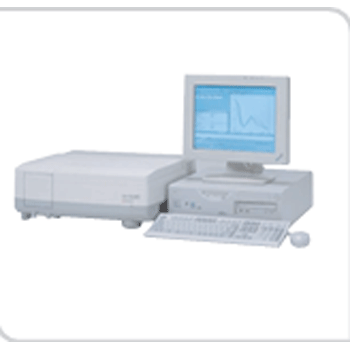 UV Vis Spectrophotometer
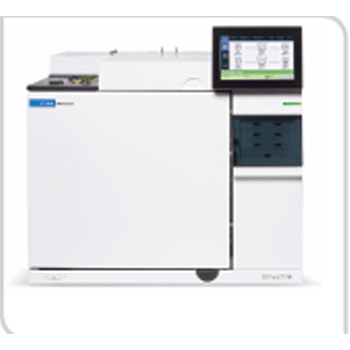 Gas Chramatograp (GC)
 FT-IR Spectrometer
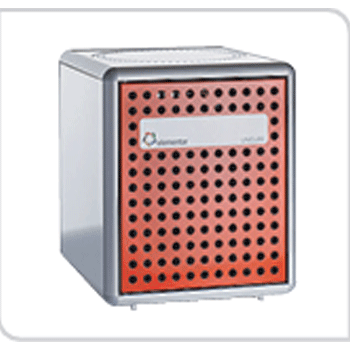 CHNS Analyzer
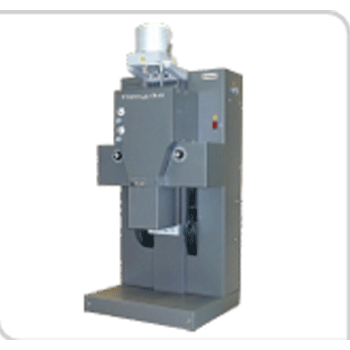 Simultaneous Thermal Analysis (TGA DTA)