
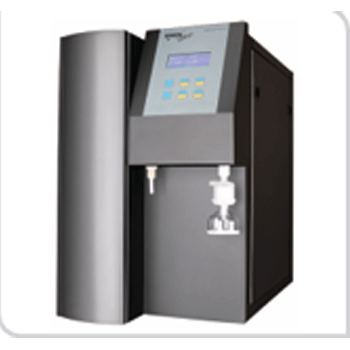
Here's a breakdown of the common stages and technologies involved in a typical water purification system:
1. Pre-treatment: Screening/Sedimentation: This initial step removes large suspended solids like leaves, sand, debris, and other visible impurities through physical filtration. This protects subsequent finer filtration stages from clogging.
pH Adjustment: The pH of the water may be adjusted to optimize the effectiveness of later treatment steps, such as coagulation and flocculation, and to ensure the final water is suitable for its intended use (e.g., preventing corrosion in pipes).
Coagulation and Flocculation: Chemicals (coagulants) are added to the water to neutralize the charges of tiny suspended particles, causing them to clump together into larger, heavier "flocs."
Sedimentation: The water then flows into sedimentation basins where the heavier flocs settle to the bottom by gravity, forming sludge that is removed.
2. Filtration:
Sand Filters (Rapid or Slow): Water passes through layers of sand and gravel, which trap remaining suspended particles, microorganisms, and some dissolved substances.
Activated Carbon Filters: These filters utilize activated carbon, which has a highly porous structure, to adsorb (trap) organic compounds, chlorine, odors, tastes, and some chemicals.
Membrane Filtration (Microfiltration, Ultrafiltration, Nanofiltration, Reverse Osmosis - RO): These advanced methods use semi-permeable membranes with microscopic pores.
3. Disinfection:
Chlorination: Chlorine or chlorine compounds are added to kill or inactivate remaining bacteria, viruses, and other pathogens.
Ultraviolet (UV) Disinfection: UV light systems use short-wavelength ultraviolet radiation to damage the DNA of microorganisms, preventing them from reproducing and rendering them harmless.
Ozone Disinfection: Ozone gas is a powerful oxidizing agent that effectively destroys bacteria, viruses, and other organic contaminants.
4. Additional Treatment Options (depending on specific needs):
Ion Exchange: Used to remove specific undesirable ions (e.g., hardness-causing minerals like calcium and magnesium, or heavy metals) by exchanging them with less harmful ions (e.g., sodium).
Distillation: Involves boiling water to create steam, leaving impurities behind, and then condensing the steam back into pure liquid water.
Aeration: Sprays water into the air to remove dissolved gases (like hydrogen sulfide, which causes a rotten egg smell) and oxidize certain metals (like iron and manganese) for easier removal. In essence, a water purification system acts as a multi-barrier defense, progressively removing different types of contaminants to deliver water that meets the required quality standards for its intended use, contributing significantly to public health and various industrial processes.
 Atomic Absorption Spectrophotometer
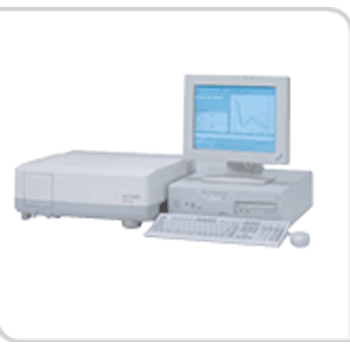 UV Vis Spectrophotometer
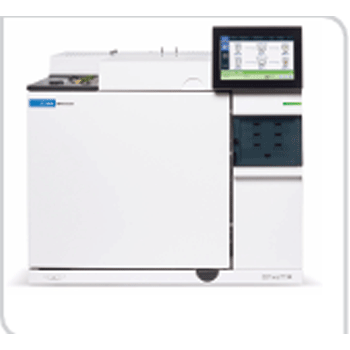 Gas Chramatograp (GC)
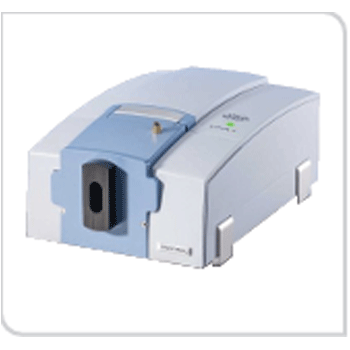 FT-IR Spectrometer
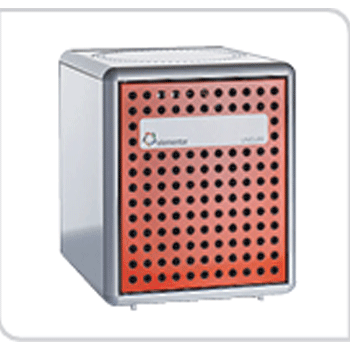 CHNS Analyzer
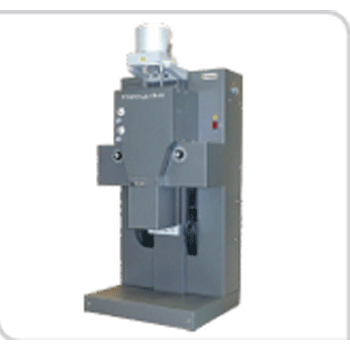 Simultaneous Thermal Analysis (TGA DTA)