
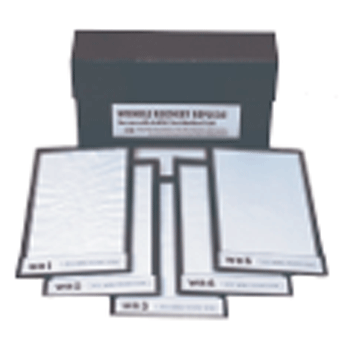
AATCC Test Method 128, "Wrinkle Recovery of Fabrics: Appearance Method."
AATCC Wrinkle Recovery Replicas are a set of three-dimensional (3D) plastic reference standards used to visually evaluate the wrinkle recovery of textile fabrics.
Purpose: The primary purpose of these replicas is to provide a standardized, objective scale for assessing how well a fabric recovers its original smooth appearance after being subjected to induced wrinkling.
Construction: The replicas are typically made of durable plastic and are 3D, meaning they accurately represent different levels of wrinkling with depth and form.
Grading Scale: A set of AATCC Wrinkle Recovery Replicas usually consists of five replicas, corresponding to a rating scale from 1 to 5, where:
1: Represents severe wrinkling (poor recovery).
5: Represents excellent wrinkle recovery (very smooth, few wrinkles).
The intermediate ratings (2, 3, 4) represent varying degrees of wrinkle recovery in between.
Usage in AATCC TM128:
A fabric specimen is prepared and subjected to a controlled wrinkling process using an AATCC Wrinkle Tester, where it's held under a predetermined load for a specific period.
After the wrinkling, the specimen is removed and allowed to recover its shape under standard atmospheric conditions for a set time (e.g., 24 hours).
Finally, trained evaluators compare the appearance of the test specimen to the AATCC Wrinkle Recovery Replicas.
Importance: These replicas are essential for ensuring consistency and reproducibility in wrinkle recovery testing across different laboratories and evaluators. By providing a tangible, standardized visual reference, they help minimize subjectivity in the assessment process.
Maintenance: Like all physical standards, AATCC Wrinkle Recovery Replicas can wear out over time.
 Multifibre DW 2115: 10 Metre Roll
 Multifibre LyoW 2165: 10 Metre Roll (A) Non-Phosphate)
 SDCE Cotton Lawn 1323:5𐤕5cm (Gimped) 500 Piece Pack
 Impregnated Test Papers
 Control Fabric 10𐤕3cm 25 Piece Pack
 BHT Free 63 Micron Film 400Piece Pack