
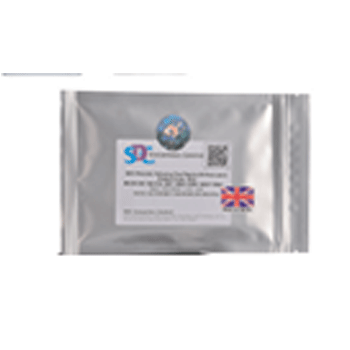
Manufacturers: Reputable manufacturers of impregnated test papers include James Heal, SDC, and SDL Atlas, among others. It's crucial to use authentic products to ensure accuracy and consistency of results, as counterfeit products can compromise testing integrity and potentially pose health and safety risks.
Purpose: The primary use of impregnated test papers is to predict and evaluate the potential for white or pastel-colored textile materials (yarns, fabrics, garments) to develop a yellow discoloration. This "phenolic yellowing" is a common problem caused by the reaction of certain phenolic compounds (often present in packaging materials like polyethylene films, or in finishing agents) with nitrogen oxides from the atmosphere during storage or transit.
Composition: These papers are typically made of cellulose and are "impregnated" or treated with a specific chemical reagent (a "yellowable phenol"). When the test paper comes into contact with a textile sample that is susceptible to phenolic yellowing, and in the presence of nitrogen oxides (often from the air or through accelerated testing conditions), the impregnated chemical reacts, causing the paper and/or the textile to turn yellow.
Test Procedure (General):
A textile specimen is typically folded between two pieces of the impregnated test paper.
This "sandwich" is then placed between glass plates, often with other test specimens and a control fabric.
The package is wrapped in a BHT (butylated hydroxytoluene)-free polyethylene film (BHT is a common antioxidant that can cause yellowing itself and would interfere with the test).
A specific pressure (e.g., using a perspiration stand and weight) is applied.
The setup is then placed in an oven at a controlled temperature (e.g., 50°C) for a set duration (e.g., 16 hours).
After the incubation period, the specimens are removed and compared to their original state and/or a standard grey scale for staining to assess the intensity of yellowing.
Standards: Impregnated test papers are used in accordance with international and industry-specific standards, such as:
ISO 105-X18
M&S C20B
NEXT TM43
Arcadia AG16
TESCO TM/137/01
Manufacturers: Reputable manufacturers of impregnated test papers include James Heal, SDC, and SDL Atlas, among others. It's crucial to use authentic products to ensure accuracy and consistency of results, as counterfeit products can compromise testing integrity and potentially pose health and safety risks.
Storage and Handling: These papers should be stored at ambient temperatures (e.g., 10-30°C) in dry conditions and in their original, sealed packaging to prevent contamination and degradation of the active ingredients. Once opened, their shelf life for accurate results may be limited (e.g., 3-6 months).
In essence, impregnated test papers are a vital tool in textile quality control, helping manufacturers and retailers predict and mitigate issues related to yellowing in light-colored fabrics, ensuring product quality and customer satisfaction.
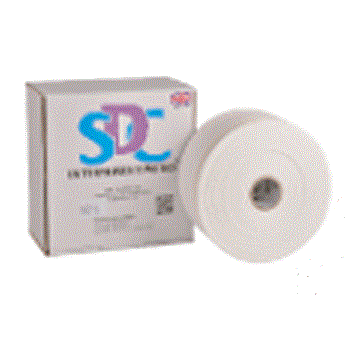 Multifibre DW 2115: 10 Metre Roll
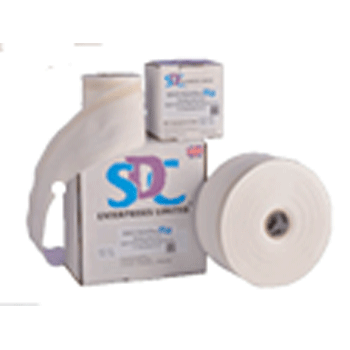 Multifibre LyoW 2165: 10 Metre Roll (A) Non-Phosphate)
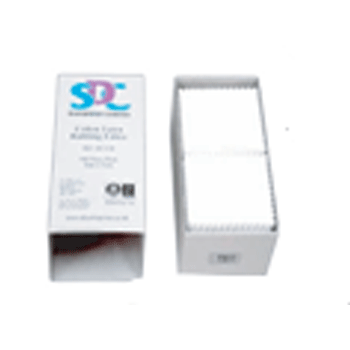 SDCE Cotton Lawn 1323:5𐤕5cm (Gimped) 500 Piece Pack
 Control Fabric 10𐤕3cm 25 Piece Pack
 BHT Free 63 Micron Film 400Piece Pack