Description
Purpose: Multifibre DW is primarily used as an adjacent fabric in various colourfastness tests, most notably those specified by ISO 105 (C and E Series). These tests assess how well a dyed textile retains its colour when subjected to different conditions, such as washing, perspiration, water, dry cleaning, and rubbing. The multifibre fabric is sewn alongside the test sample to determine if any colour bleeds or stains other fibres during the testing process.
Composition: The "DW" in Multifibre DW stands for "Dry/Wet" or refers to its original development by the Society of Dyers & Colourists (SDC). It is specifically designed to contain six different fibre components woven together in narrow strips. These components typically include:
Acetate (Filament Acetate or Secondary Cellulose Acetate)
Bleached Cotton
Spun Nylon 6.6 (Polyamide)
Spun Polyester
Acrylic
Worsted Wool
Construction:
It is produced with a narrow weave construction.
Often, it features a ribbon construction for economy, ease of handling, and stability during use.
Some manufacturers incorporate an identification weave or a security thread (like those from SDC Enterprises) to ensure authenticity and easy recognition.
The different fibre strips are typically about 15 mm wide.
Quality Control: Reputable manufacturers (like SDC Enterprises and James Heal) put Multifibre DW through rigorous quality control procedures. This includes testing individual yarns before weaving and further tests on the finished product. Each batch must pass these tests, often conducted by independent UKAS-accredited laboratories, to ensure consistent staining behaviour and compliance with standards like ISO 105 F10.
Form Factor (10 Metre Roll): The "10 Metre Roll" indicates the length in which the fabric is supplied. This provides ample material for multiple tests and allows users to cut precise sample sizes as needed. Other common lengths include 50-metre and 100-metre rolls, and it can also be supplied in pre-cut pieces.
Key Advantages:
Provides a standardized and consistent material for comparative colourfastness testing.
Allows assessment of colour transfer/staining onto a variety of common textile fibres.
Meets various international standards (e.g., ISO 105 F10) and specific chain store fastness test specifications (e.g., M&S, NEXT, ADIDAS).
Ensures reliable and reproducible test results for quality control and product development.

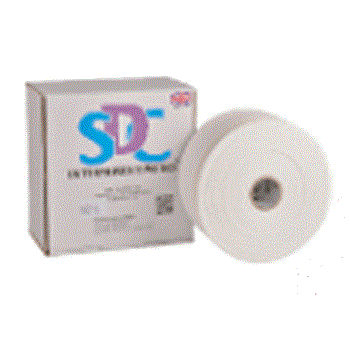
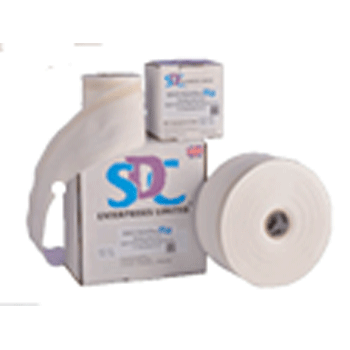 Multifibre LyoW 2165: 10 Metre Roll (A) Non-Phosphate)
 SDCE Cotton Lawn 1323:5𐤕5cm (Gimped) 500 Piece Pack
 Impregnated Test Papers
 Control Fabric 10𐤕3cm 25 Piece Pack
 BHT Free 63 Micron Film 400Piece Pack