
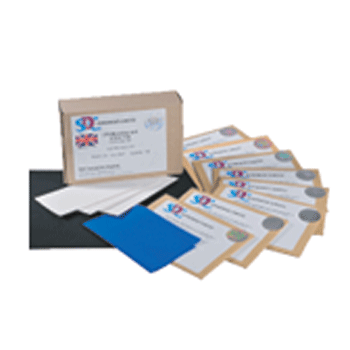
Blue Wool Standards are a critical component in the testing of lightfastness and weathering of various materials, particularly textiles, but also increasingly inks, pigments, and polymers. They consist of a series of eight wool swatches, each dyed with a different blue dye, ranging from 1 to
Purpose: Blue Wool Standards are used to measure and calibrate how well a colored material resists fading when exposed to light.
Scale: The scale is designed so that each successive swatch (e.g., #2 compared to #1) takes approximately two to three times longer to show a perceptible fade.
Blue Wool 1: Fades very quickly, indicating very poor lightfastness (fugitive).
Blue Wool 8: Has excellent resistance to fading, indicating high lightfastness.
How they work: In lightfastness testing, a sample of the material being tested is exposed to a controlled light source (often a Xenon arc lamp that mimics natural daylight) alongside the Blue Wool Standards. By comparing the fading of the test sample to the fading of the Blue Wool Standards, a lightfastness rating can be assigned.
Standards: There are international (ISO) and American (AATCC) versions of Blue Wool Standards, both serving the same purpose but with slight differences in their production and some testing conditions.
Humidity and Blue Wool Standards / Humidity Test Materials:
While Blue Wool Standards are primarily for lightfastness, humidity is a crucial factor in weathering and overall material degradation, and it significantly influences how these tests are conducted and how materials behave.
Here's the connection:
Impact on Fading: Humidity, along with temperature and light intensity, directly affects the rate at which materials fade.
Controlled Environments: Lightfastness and weathering tests are typically performed in controlled environmental chambers that can regulate temperature and humidity.
Typical Conditions: For ISO 105-B02 (a common lightfastness standard), typical conditions include specific irradiance (light intensity), temperature (e.g., 50°C Black Standard Temperature), and relative humidity (e.g., 40% effective humidity).
Humidity Test Control Fabrics: To ensure the accuracy of humidity settings within these testing machines, a special humidity test control fabric (often an azoic dyed cotton fabric, sometimes referred to as "red azoic fabric") is used.
Moisture Meters/Humidity Testers for Textiles: Beyond the controlled chamber environment, there are also dedicated textile moisture meters and humidity testers.
Environmental Chambers: For comprehensive humidity and temperature testing of textiles, Textile Temperature and Humidity Test Chambers are used.
In summary, while Blue Wool Standards are the benchmark for lightfastness, the overall performance and degradation of materials like wool are heavily influenced by humidity. Therefore, humidity control and the use of specific humidity test materials are integral to accurate and reliable material testing in the textile and related industries.
 Multifibre DW 2115: 10 Metre Roll
 Multifibre LyoW 2165: 10 Metre Roll (A) Non-Phosphate)
 SDCE Cotton Lawn 1323:5𐤕5cm (Gimped) 500 Piece Pack
 Impregnated Test Papers
 Control Fabric 10𐤕3cm 25 Piece Pack
 BHT Free 63 Micron Film 400Piece Pack