
DescriptMechanism of Fluorescent Brightening Agents (FBAs): FBAs work on the principle of fluorescence. When exposed to UV light (e.g., from sunlight or artificial light), their molecules get excited. As these excited molecules return to their ground state, they release the absorbed energy as visible blue light. This phenomenon effectively shifts the spectrum of light reflected from the material towards the blue end, compensating for any natural yellowing and creating a brighter, whiter appearance.ion
Quality Control and Assessment: In industries like textiles, leather, and paper, color assessment and grading often require a neutral background. The presence of strong fluorescence from FBAs can interfere with accurate color matching and assessment under standard viewing conditions.
Specific Product Requirements: For certain applications, a non-fluorescent material might be desired. For example, some baby articles or specific medical textiles might need to be free of optical brighteners.
Recycled Materials: Recycled pulp for paper production can contain residual fluorescent agents from previous uses.
Correcting Over-brightening: Sometimes, an excessive amount of FBA might lead to an unnaturally blue-white appearance. Suppressors can help in toning down this effect.
Mechanisms of Fluorescence Quenching (Suppression): Fluorescence quenching can occur through various mechanisms, broadly categorized into:
Static Quenching: This involves the formation of a non-fluorescent complex between the FBA molecule and the quencher molecule in the ground state (before excitation).
Dynamic/Collisional Quenching: In this mechanism, the excited FBA molecule collides with a quencher molecule, leading to a non-radiative transfer of energy.
Energy Transfer (e.g., FRET - Förster Resonance Energy Transfer): Energy is transferred from the excited FBA (donor) to an acceptor molecule (quencher) through non-radiative dipole-dipole interactions. The acceptor then either emits light at a different wavelength or dissipates the energy as heat.
Photoinduced Electron Transfer: An electron is transferred from the excited FBA to the quencher, leading to a non-fluorescent state.
Chemical Degradation: Some suppressors, particularly in industrial processes, work by chemically degrading the FBA molecules, destroying their fluorescent properties. Examples include the use of oxidizing agents like chlorine dioxide or peracetic acid in textile processing.
Application Across Industries:
Textiles: Fluorescence suppressors are used in textile testing to accurately assess color fastness and shade without interference from OBAs.
Leather: Similar to textiles, fluorescence suppressors are employed in the leather industry for accurate color grading and quality control, especially when dealing with leather treated with brightening agents.
Paper: In paper manufacturing, fluorescence quenchers are crucial for controlling the whiteness and opacity of paper, particularly when using recycled pulp which may contain varying levels of residual FBAs.
In summary, while fluorescent brightening agents are vital for enhancing the visual appeal of textiles, leather, and paper, fluorescence suppressors provide the necessary control to ensure accurate assessment, meet specific product requirements, and manage the effects of brighteners in complex manufacturing processes.
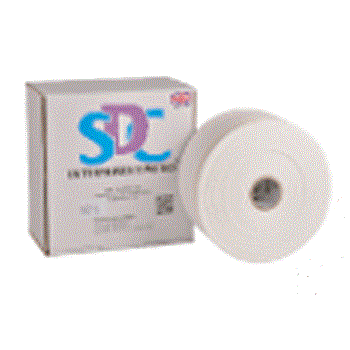 Multifibre DW 2115: 10 Metre Roll
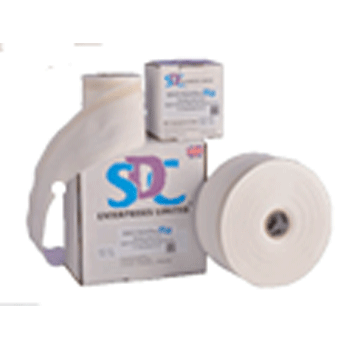 Multifibre LyoW 2165: 10 Metre Roll (A) Non-Phosphate)
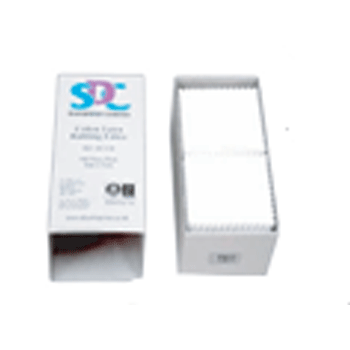 SDCE Cotton Lawn 1323:5𐤕5cm (Gimped) 500 Piece Pack
 Impregnated Test Papers
 Control Fabric 10𐤕3cm 25 Piece Pack
 BHT Free 63 Micron Film 400Piece Pack