
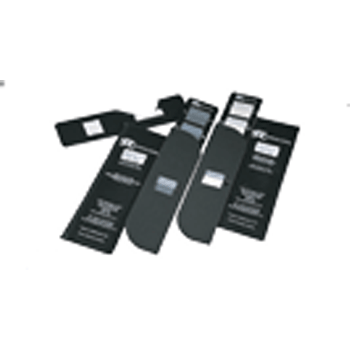
Grey Scale: These are standardized visual aids used to assess changes in color and staining. There are typically two main types:
Grey Scale: These are standardized visual aids used to assess changes in color and staining. There are typically two main types:
Grey Scale for Color Change: This scale consists of nine pairs of grey-colored chips, ranging from grade 5 (no change) to grade 1 (severe change). Each pair represents a specific perceived color difference.
Grey Scale for Staining: This scale consists of nine pairs of grey and white colored chips, used to evaluate the degree of staining on undyed adjacent fabrics. Again, grade 5 indicates no staining, and grade 1 indicates severe staining.
Change in Colour Assessing: This refers to the process of evaluating how much a material's original color has shifted or faded after being subjected to various tests (e.g., washing, light exposure, perspiration, rubbing). The Grey Scale for Color Change is used for this assessment.
Assessing Staining: This refers to the process of evaluating how much color has transferred from a dyed material to an undyed adjacent fabric during testing. The Grey Scale for Staining is used for this assessment.
Includes Assessment Mask: An assessment mask is a crucial component used with the grey scales. It is typically a piece of material, often with precisely cut openings, that helps the evaluator isolate the area being assessed.
Purpose of the Mask:
Focus: It helps to focus the eye on the specific area of the sample and the corresponding grey scale chip, preventing distractions from surrounding colors.
Isolation: It isolates the test specimen and the grey scale from other areas of the material, ensuring that only the relevant sections are compared.
Standardization: It promotes consistency in the assessment process by ensuring a uniform viewing area.
How they are used:
In colorfastness testing, a test specimen is subjected to a specific condition (e.g., washing). After the test, the treated specimen (and any adjacent fabrics for staining) is compared visually to the original, untreated specimen (and the original undyed fabric for staining) using the appropriate grey scale. The assessment is typically done under standardized lighting conditions (e.g., D65 illuminant) and at a specific viewing angle (e.g., 45 degrees). The mask is placed over the samples and the grey scale to aid in this comparison.
The ratings obtained (from 1 to 5, with half-step increments like 4-5, 3-4, etc.) indicate the level of color change or staining, helping manufacturers and consumers understand the durability and quality of textile products. These scales are manufactured in accordance with international standards such as ISO 105-A02 (for color change) and ISO 105-A03 (for staining), as well as AATCC and other national standards.
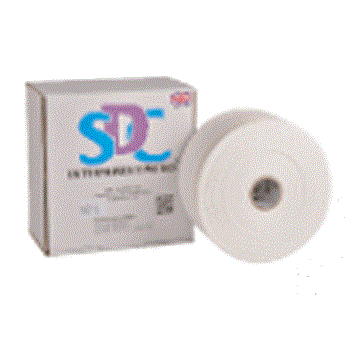 Multifibre DW 2115: 10 Metre Roll
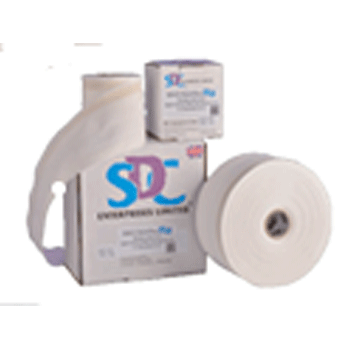 Multifibre LyoW 2165: 10 Metre Roll (A) Non-Phosphate)
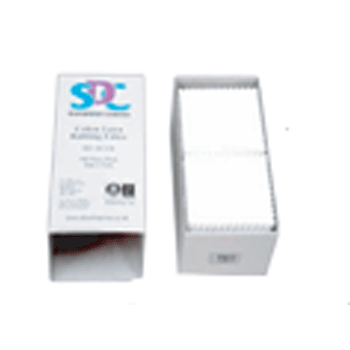 SDCE Cotton Lawn 1323:5𐤕5cm (Gimped) 500 Piece Pack
 Impregnated Test Papers
 Control Fabric 10𐤕3cm 25 Piece Pack
 BHT Free 63 Micron Film 400Piece Pack