
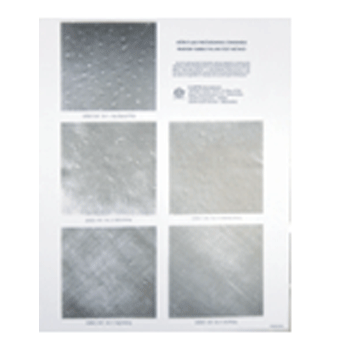
Graded Photographs: Pilling photographic standards consist of a set of photographs, typically on a single sheet or as individual cards, that depict varying degrees of pilling on specific types of fabrics (e.g., woven, knitted, different fiber compositions).
Graded Photographs: Pilling photographic standards consist of a set of photographs, typically on a single sheet or as individual cards, that depict varying degrees of pilling on specific types of fabrics (e.g., woven, knitted, different fiber compositions).
Numbered Scale: These photographs are graded on an arbitrary scale, usually from 1 to 5, where:
Grade 5 (or higher, depending on the standard): Represents no pilling or very slight pilling.
Grade 1 (or lower): Represents very severe pilling.
Intermediate grades show increasing levels of pilling.
Standardized Production: Reputable manufacturers produce these photographs under strictly controlled conditions to ensure consistency between batches and across different users.
Specific to Test Methods: Different standards organizations (e.g., ASTM, ISO, M&S, Woolmark) and test methods (e.g., Random Tumble, Martindale, ICI Pilling Box) have their own sets of photographic standards, which are designed to correlate with the type of pilling produced by that particular testing method.
Visual Comparison: After a fabric specimen has been subjected to a pilling test in a laboratory, its surface is visually compared to the pilling photographic standards.
Assigning a Grade: An evaluator determines which photographic standard most closely matches the appearance of the tested fabric specimen, thereby assigning a pilling grade. Half marks are often allowed for more nuanced assessment.
Objective Evaluation: The standards provide a common reference point, helping to minimize subjectivity in pilling assessment and ensuring more consistent and reproducible results across different laboratories and evaluators.
Quality Control and Development:
Quality Control: Manufacturers use these standards to ensure their products meet certain quality requirements and specifications for pilling resistance.
Product Development: They are used in the development of new fabrics and finishes to assess and improve their pilling performance.
Acceptance Testing: While some standards may recommend caution for acceptance testing due to interlaboratory variability, they are still widely used for this purpose in commercial agreements between purchasers and suppliers.
Key characteristics and considerations:
Fabric Type Specificity: It's important to use the correct photographic standards for the type of fabric being tested, as pilling can manifest differently on woven versus knitted fabrics, or on fabrics made from different fibers.
Illumination: Proper illumination, often with a standardized light source like CIE D65 artificial daylight, is crucial for accurate visual assessment. Pilling assessment viewers (PAVs) are designed to provide consistent lighting conditions.
Fuzz vs. Pills: While pilling standards primarily address the formation of pills, other surface phenomena like "fuzzing" (protruding fiber ends that haven't yet formed pills) can also be present and contribute to the overall appearance. Some standards consider these related surface changes.
Limitations of Visual Assessment: Despite the use of photographic standards to improve objectivity, visual assessment still inherently involves a degree of human perception. This has led to research and development in objective, image-processing based pilling assessment systems.
In essence, Pilling Photographic Standards are an indispensable tool for standardizing the evaluation of a fabric's resistance to pilling, enabling consistent and reliable assessment within the textile industry.
 Multifibre DW 2115: 10 Metre Roll
 Multifibre LyoW 2165: 10 Metre Roll (A) Non-Phosphate)
 SDCE Cotton Lawn 1323:5𐤕5cm (Gimped) 500 Piece Pack
 Impregnated Test Papers
 Control Fabric 10𐤕3cm 25 Piece Pack
 BHT Free 63 Micron Film 400Piece Pack