
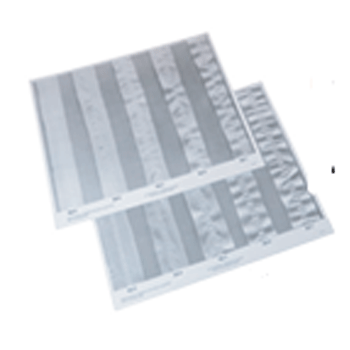
Purpose: To provide a standardized method for visually assessing the smoothness and appearance of seams in textiles, often after being subjected to home laundering procedures. This helps in quality control, product development, and ensuring consistent fabric and garment appearance.
Photographic Scales: The AATCC scale consists of photographic replicas representing different levels of seam smoothness. These scales are designed for both single-needle and double-needle seams.
Visual Comparison: Specimens (fabrics with seams) are laundered according to specific AATCC test methods (e.g., AATCC TM88B for seam smoothness after home laundering, and AATCC TM143 for appearance of apparel after home laundering). After laundering, the seams are compared visually to the photographic standards in a standardized viewing area.
Grading System: A numerical grading system is used, typically ranging from 1 to 5, where:
Grade 5: Represents the smoothest appearance, with no puckering, rippling, or distortion along the seam. It's the most desirable outcome.
Grade 4: Shows slight puckering or distortion, but the seam is still generally smooth and acceptable.
Grade 3: Indicates moderate puckering or distortion, which is noticeable but not severe.
Grade 2: Displays significant puckering or distortion, making the seam appear quite uneven and undesirable.
Grade 1: Represents the least smooth appearance, with severe puckering, rippling, or other distortions that significantly detract from the seam's appearance.
Key Aspects and Considerations:
Objective Evaluation: While it involves visual comparison, the use of standardized photographic replicas aims to make the evaluation as objective as possible, minimizing individual bias.
Impact of Laundering: The scale is crucial for assessing how seams hold up to repeated washing and drying, which is a major factor in garment durability and appearance retention.
Factors Affecting Seam Smoothness: Various factors can influence seam smoothness, including:
Fabric type (woven, knit, nonwoven)
Yarn type and construction
Stitch type and density (stitches per inch - SPI)
Thread tension
Sewing machine settings
Seam allowance
Fabric finishes (e.g., durable press)
Maintenance of Scales: The AATCC photographic scales are typically recommended to be replaced every three years to ensure their accuracy and prevent fading or deterioration.
In essence, the Seam Smoothness Rating Scale provides a common language and visual benchmark for evaluating the aesthetic quality of seams in textile products, helping manufacturers maintain quality standards and consumer satisfaction.
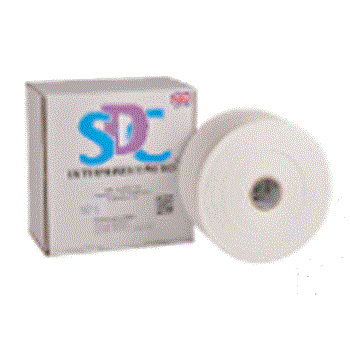 Multifibre DW 2115: 10 Metre Roll
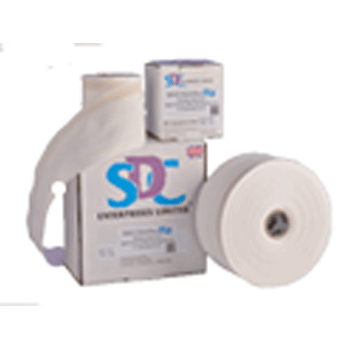 Multifibre LyoW 2165: 10 Metre Roll (A) Non-Phosphate)
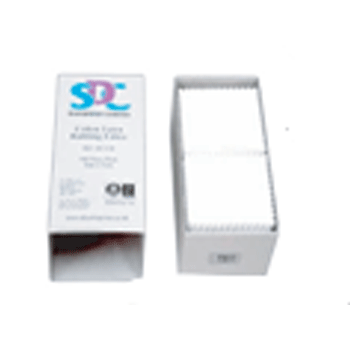 SDCE Cotton Lawn 1323:5𐤕5cm (Gimped) 500 Piece Pack
 Impregnated Test Papers
 Control Fabric 10𐤕3cm 25 Piece Pack
 BHT Free 63 Micron Film 400Piece Pack