
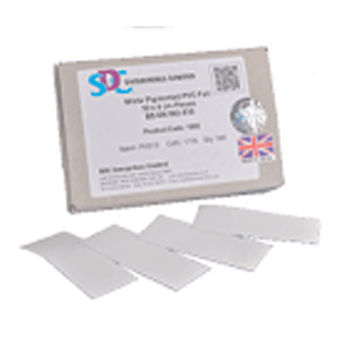
Polyvinyl Chloride (PVC), to which white pigments, most commonly titanium dioxide (TiO2), have been added. These pigments are incorporated into the PVC resin during the manufacturing process to impart a bright, opaque white color.
A white pigmented PVC foil is a thin sheet or film made primarily from Polyvinyl Chloride (PVC), to which white pigments, most commonly titanium dioxide (TiO2), have been added. These pigments are incorporated into the PVC resin during the manufacturing process to impart a bright, opaque white color.
Here's a breakdown of its description, properties, and uses:
Composition and Manufacturing:
Polyvinyl Chloride (PVC): The base material, PVC, is a versatile thermoplastic polymer.
White Pigment (primarily Titanium Dioxide - TiO2): TiO2 is highly valued for its exceptional opacity, brightness, and ability to effectively conceal the base color of the plastic.
Additives: Various additives are typically included to enhance the foil's properties, such as:
Plasticizers: To increase flexibility and workability (for flexible PVC foils).
Heat Stabilizers: To prevent degradation during processing and extend the product's lifespan by protecting against heat aging.
UV Stabilizers: To improve resistance to UV radiation, preventing color fading and material deterioration, especially for outdoor applications.
Processing Aids and Impact Modifiers: To improve manufacturing efficiency and the foil's overall toughness.
Manufacturing Process: White pigmented PVC foils are typically produced through processes like calendering or extrusion.
Calendering: PVC resin, pigments, and additives are mixed, then heated and passed through a series of heated rollers to form a continuous sheet of desired thickness.
Extrusion: The mixed compound is melted and forced through a die to create the foil.
Hot Stamping Foils: In some cases, the "foil" refers to a multi-layered hot stamping foil, where a white pigment layer is applied to a polyester (PET) carrier film, along with release and adhesive layers. This type of foil is transferred to a substrate using heat and pressure.
Key Properties:
Opacity and Color Consistency: The primary characteristic is its brilliant white color and high opacity, which ensures that printed designs or underlying surfaces are not visible through the foil.
Printability: It generally offers a smooth, non-porous surface that accepts various printing techniques well, including screen printing, digital inkjet, and offset printing, allowing for sharp, high-resolution graphics.
Durability and Weather Resistance: PVC itself is known for its toughness, resisting abrasion, moisture, and chemical exposure.
Chemical Stability: Exhibits good resistance to many acids, alkalis, and solvents, making it suitable for applications where exposure to such substances is possible.
Flexibility (variable): Depending on the plasticizer content, the foil can range from rigid (unplasticized PVC) to highly flexible, suiting various application needs (e.g., rigid for cards, flexible for wraps).
Dimensional Stability: Resists shrinkage or warping after processing or printing, ensuring consistent results.
Cost-Effectiveness: PVC is generally an economical material, making white pigmented PVC foils a cost-effective solution for many applications.
Textile Testing: Used in specific laboratory tests (e.g., ISO 105 X10) to assess the color migration of textile dyes into polyvinyl chloride coatings.
Hot Stamping/Foil Printing: As a pigment foil, it's widely used in the hot stamping process to apply a white, opaque finish to various substrates like paper, cardboard, plastics (including PVC itself), leather, and textiles.
Labels and Decals: Its excellent printability, opacity, and durability make it suitable for a wide range of labels, stickers, and decals, including those for outdoor use or in environments exposed to chemicals.
Signage and Advertising: Used for promotional banners, billboards, and other display materials where a bright, weather-resistant white background is required.
Packaging: Employed in various packaging applications for its visual appeal and protective qualities.
Conveyor Belt Joints: Flexible white PVC foil can be used for splicing and joining conveyor belts.
Decorative Films: Used as decorative films for surfaces in furniture, interior design, and other applications where a durable, aesthetically pleasing white finish is desired.
 Multifibre DW 2115: 10 Metre Roll
 Multifibre LyoW 2165: 10 Metre Roll (A) Non-Phosphate)
 SDCE Cotton Lawn 1323:5𐤕5cm (Gimped) 500 Piece Pack
 Impregnated Test Papers
 Control Fabric 10𐤕3cm 25 Piece Pack
 BHT Free 63 Micron Film 400Piece Pack