
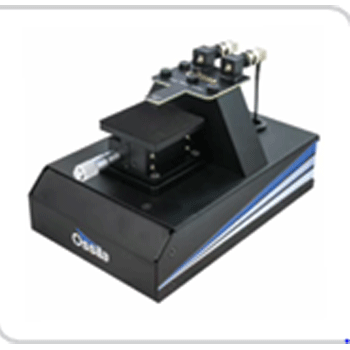
1. Working Principle: The core idea behind the four-point probe method is to decouple the measurement of resistance from the contact resistance between the probes and the material. This is achieved by using four co-linear (in a straight line) and equally spaced probes:
The Four-Point Probe is a widely used and highly effective apparatus for measuring the electrical resistivity and sheet resistance of materials, particularly semiconductors and thin films. It's a standard tool in microelectronics, materials science research, and process control.
Here's a breakdown of its key aspects:
1. Working Principle: The core idea behind the four-point probe method is to decouple the measurement of resistance from the contact resistance between the probes and the material. This is achieved by using four co-linear (in a straight line) and equally spaced probes:
Outer Probes (Current Source): A precisely controlled current (I) is passed through the two outer probes, which are in contact with the sample.
Inner Probes (Voltage Measurement): The voltage drop (ΔV) across the material is measured between the two inner probes. Since negligible current flows through these inner probes (due to their connection to a high-impedance voltmeter), the measured voltage drop is solely due to the material's resistance, effectively eliminating the influence of contact resistance.
2. Why Four Probes? Traditional two-probe resistance measurements suffer from errors introduced by the contact resistance between the probes and the sample, as well as the resistance of the wires connecting the probes to the meter. By separating the current-sourcing and voltage-sensing functions, the four-point probe method bypasses these issues, leading to much more accurate measurements of the material's intrinsic resistivity.
3. Resistivity and Sheet Resistance:
Resistivity (): This is an intrinsic property of a material, representing its opposition to electrical current flow. It's typically measured in ohm-centimeters () for bulk materials. The formula for bulk resistivity often includes a geometric correction factor (k) that depends on the sample's dimensions and the probe spacing:
Sheet Resistance (): This parameter is used for thin films or surface layers, and it represents the resistance of a thin square of the material. Its unit is typically ohms per square (Ω/□). Sheet resistance is related to bulk resistivity by the film thickness (t):
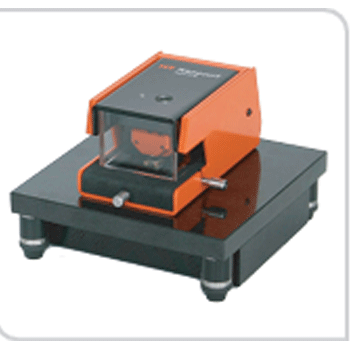 Atomic Force Microscope AFM
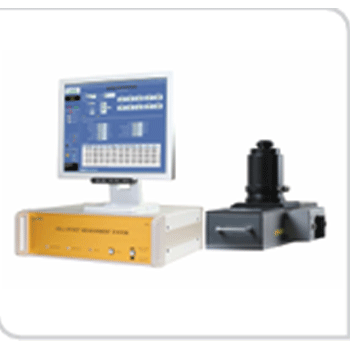 Hall Effect Meserment System
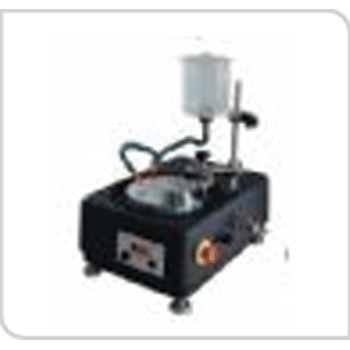 Polishing & Grainding Machine
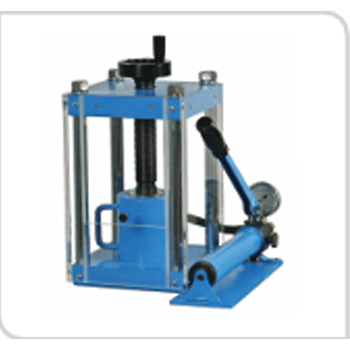 Lab Press With Hydraulic Pump
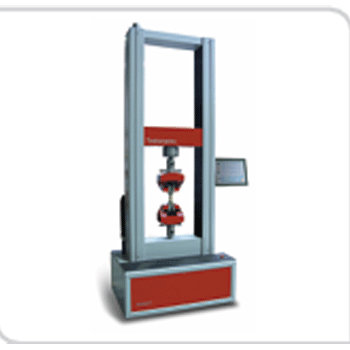 Universal Tensile Tester (UTM)