
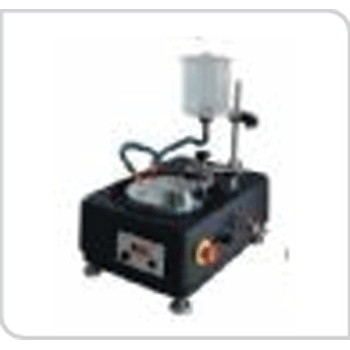
A Polishing & Grinding Machine is a versatile piece of equipment used in various industries to refine the surface of workpieces. While often discussed together due to their similar objective of surface finishing, grinding and polishing are distinct processes with different aims and outcomes. Grinding is a machining process that uses abrasive tools, such as grinding wheels, belts, or discs, to remove material from a workpiece through abrasion. Its primary purpose is to:
A Polishing & Grinding Machine is a versatile piece of equipment used in various industries to refine the surface of workpieces.
Grinding is a machining process that uses abrasive tools, such as grinding wheels, belts, or discs, to remove material from a workpiece through abrasion.
Shape and size components: Grinding can achieve precise dimensions and tolerances, often for hard materials that are difficult to machine by other methods.
Remove excess material: It efficiently takes off unwanted material, burrs, or rough projections from castings, stampings, or previously machined parts.
Correct surface irregularities: It can level and smooth surfaces, preparing them for further finishing.
Key characteristics of grinding:
High material removal rate: It's effective for fast shaping and sizing.
Uses coarser abrasives: Grinding wheels are made of abrasive grains (like silicon carbide, aluminum oxide, diamond, or cubic boron nitride) bonded together.
Results in a matte or slightly rough surface: The finish depends on the abrasive grit used.
Polishing, on the other hand, is a finishing process designed to create a smooth, reflective, and often mirror-like surface.
Enhance surface finish: It removes minor imperfections, scratches, and grinding marks left from previous operations.
Improve aesthetics: Polishing provides a visually appealing, shiny look.
Increase functionality: A smoother surface can reduce friction in moving parts and enhance corrosion resistance.
Key characteristics of polishing:
Minimal material removal: Polishing focuses on refining the surface rather than significantly altering the shape.
Uses finer abrasives: Polishing often employs soft pads, cloths, or wheels with very fine abrasive compounds (like diamond suspension or alumina slurry).
Produces a smooth, reflective finish: The goal is a blemish-free surface.
How they work (general principle):
Both grinding and polishing machines utilize a rotating abrasive element (wheel, belt, disc, or pad) that comes into contact with the workpiece.
Common components of these machines:
Base/Bed: Provides stability and support for all machine parts, often absorbing vibrations.
Motor: Drives the rotation of the abrasive tool.
Abrasive Tool: The grinding wheel, abrasive belt, polishing pad, or buffing wheel, which does the actual work.
Work Table/Chuck: Holds and positions the workpiece.
Feed Mechanism: Controls the movement of the workpiece against the abrasive tool.
Wheel Head: Houses the abrasive tool and allows for its rotation and positioning.
Dressing Tool (for grinders): Used to reshape and sharpen the grinding wheel as it wears.
Applications:
Polishing and grinding machines are indispensable across a wide range of industries:
Metalworking: Shaping, sharpening tools (drills, chisels), deburring, removing rust, preparing surfaces for welding, and achieving precise dimensions for machine parts (automotive, aerospace, heavy machinery).
Construction: Leveling, smoothing, and preparing concrete surfaces for polished floors.
Medical Industry: Producing precision surgical instruments and orthopedic implants.
Tool and Die Making: Sharpening and shaping cutting tools, punches, and dies.
Jewelry Manufacturing: Polishing and finishing intricate pieces.
Metallography/Material Science: Preparing samples for microscopic examination, ensuring a flat, deformation-free surface to reveal true microstructures. Optics: Achieving ultra-smooth surfaces for lenses and mirrors. In essence, while grinding focuses on aggressive material removal and shaping, polishing is the final touch to achieve a superior surface quality, enhancing both the functional performance and aesthetic appeal of a product. Many processes involve both grinding and polishing in sequence, starting with coarser grinding to achieve the desired shape and dimensions, followed by progressively finer grinding and then polishing to achieve the ultimate finish.
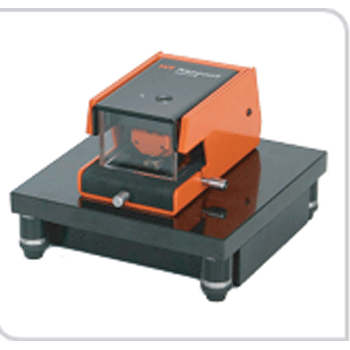 Atomic Force Microscope AFM
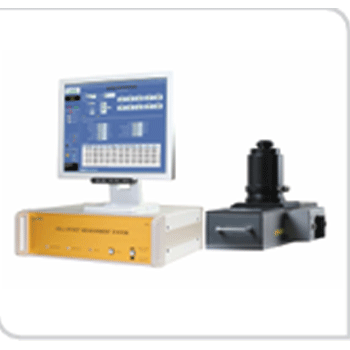 Hall Effect Meserment System
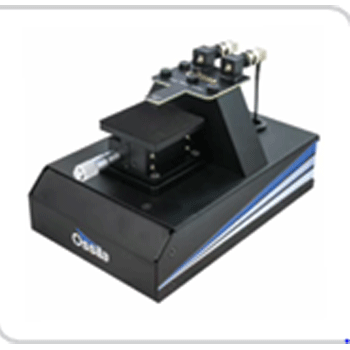 Four-Point Probe
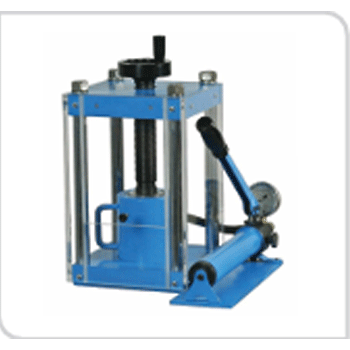 Lab Press With Hydraulic Pump
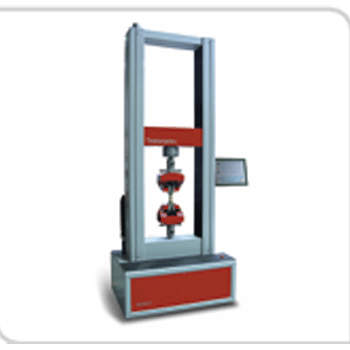 Universal Tensile Tester (UTM)