
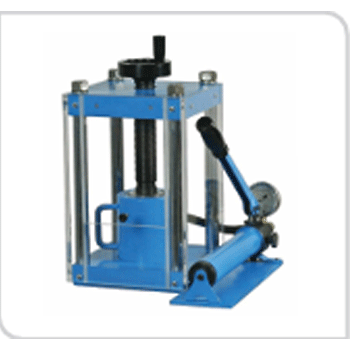
A lab press with a hydraulic pump is a piece of laboratory equipment used to apply a controlled amount of pressure to a sample. This pressure can be used for various applications, including:
A lab press with a hydraulic pump is a piece of laboratory equipment used to apply a controlled amount of pressure to a sample. This pressure can be used for various applications, including:
Pelletizing: Compressing powders into solid pellets for spectroscopy (e.g., FTIR, XRF) or other analyses.
Sample preparation: Forming samples into specific shapes or densities for testing.
Material testing: Investigating the mechanical properties of materials under compression.
Cold pressing: Consolidating powders at room temperature.
Bonding and laminating: Applying pressure to bond different materials together.
Crushing and pulverizing: Breaking down solid materials into finer particles.
Key Components and How it Works:
Press Frame: The robust, often H-frame or C-frame, structure that holds all the components and withstands the high forces generated.
Hydraulic Pump: This is the heart of the system.
Manual (Hand-Operated): A lever is manually pumped to build hydraulic pressure.
Electric (Motorized): An electric motor drives the hydraulic pump, providing faster, more consistent, and often higher pressure operation.
Air-Operated (Pneumatic-Hydraulic): Uses compressed air to power a hydraulic pump, offering a balance between manual and electric.
Hydraulic Cylinder (Ram): The pump forces hydraulic fluid into this cylinder, causing a piston (ram) to move and apply pressure to the sample.
Pressure Gauge: Essential for monitoring the applied force.
Control Valves:
Release Valve: Used to slowly release the hydraulic pressure, allowing the ram to retract.
Pump Valve/Control Lever: Controls the flow of hydraulic fluid from the pump to the cylinder.
Platens/Dies: These are the surfaces between which the sample is pressed. They can be flat or designed to accommodate specific dies or molds. Some presses offer heated platens for applications requiring temperature control.
Safety Features: Often include pressure relief valves to prevent over-pressurization, safety shields, and emergency stop buttons.
Common Features and Specifications:
Maximum Force/Tonnage: The highest pressure the press can exert (e.g., 10 tons, 25 tons, 50 tons).
Platen Size: Dimensions of the pressing surfaces.
Daylight Opening: The vertical distance between the platens when fully retracted.
Stroke Length: The maximum distance the ram can travel.
Footprint and Weight: Important for laboratory space considerations.
Temperature Control (Optional): For presses with heated platens, the maximum operating temperature and control accuracy.
Vacuum Capability (Optional): Some specialized presses offer the ability to operate under vacuum conditions.
Advantages of Hydraulic Lab Presses:
High Force Capability: Can generate very high forces in a relatively compact footprint.
Precise Control: Allows for fine adjustment and controlled application of pressure.
Versatility: Suitable for a wide range of laboratory applications.
Durability: Generally robust and long-lasting equipment. In summary, a lab press with a hydraulic pump is a fundamental tool in many research and industrial laboratories, providing the critical function of applying controlled, high-magnitude compressive forces for various material processing and analytical sample preparation tasks.
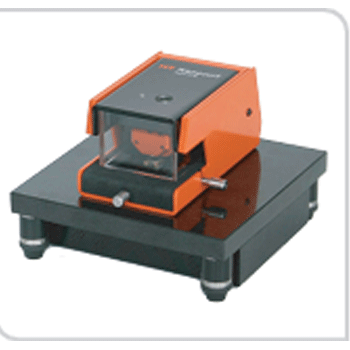 Atomic Force Microscope AFM
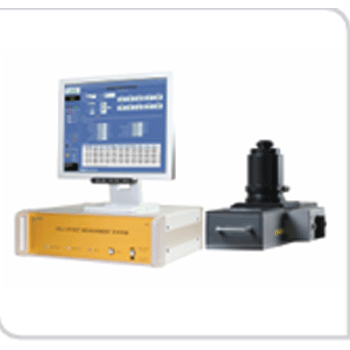 Hall Effect Meserment System
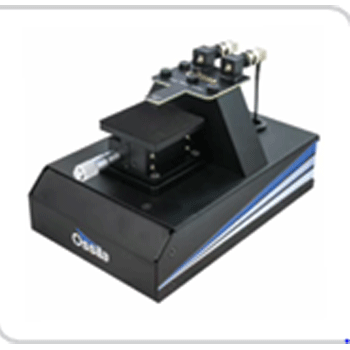 Four-Point Probe
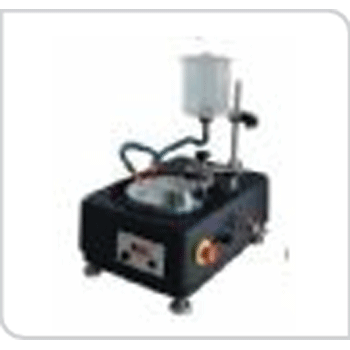 Polishing & Grainding Machine
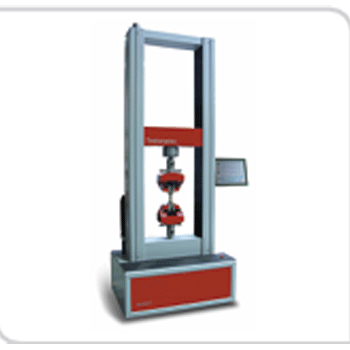 Universal Tensile Tester (UTM)