
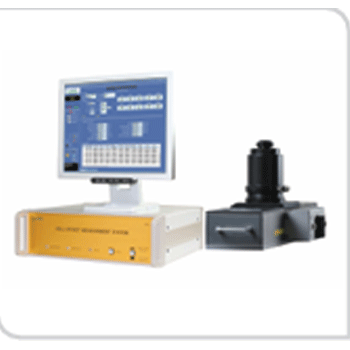
The magnitude of the Hall voltage is directly proportional to the strength of the magnetic field and the current flowing through the sample, and inversely proportional to the charge carrier concentration and the thickness of the sample. From the Hall voltage, key material parameters can be derived.
A Hall Effect Measurement System (HEMS) is a specialized instrument used to characterize the electrical properties of materials, particularly semiconductors.
When a current-carrying conductor or semiconductor is placed in a magnetic field perpendicular to the direction of current flow, a voltage is generated across the material, perpendicular to both the current and the magnetic field.
This phenomenon occurs because the magnetic field exerts a force (the Lorentz force) on the moving charge carriers (electrons or holes) within the material.
The magnitude of the Hall voltage is directly proportional to the strength of the magnetic field and the current flowing through the sample, and inversely proportional to the charge carrier concentration and the thickness of the sample. From the Hall voltage, key material parameters can be derived.
A HEMS can determine several crucial electrical properties of a material, including:
: The fundamental measurement, from which other parameters are derived.
Carrier Concentration (n): The number of charge carriers (electrons or holes) per unit volume.
Carrier Mobility A measure of how easily charge carriers can move through the material under the influence of an electric field. Higher mobility indicates better conductivity.
:Directly related to the carrier concentration and the type of charge carrier. The sign of the Hall coefficient indicates whether the material is n-type (negative carriers, electrons) or p-type (positive carriers, holes).
Conductivity Type (N or P): Determines whether the majority charge carriers are electrons (n-type) or holes (p-type).
Magnetoresistance: The change in electrical resistance of a material when a magnetic field is applied.
Constant Current Source: Supplies a precise and stable current through the sample.
High Input Impedance Voltmeter: Measures the small Hall voltage generated across the sample. It needs to be capable of accurate measurements from microvolts to 100V.
Magnetic Field Generator: This is typically a:
Permanent Magnet: Provides a constant magnetic field (e.g., 0.5T to 1T).
Electromagnet: Allows for a variable magnetic field, enabling measurements at different field strengths (e.g., up to several Tesla).
Solenoid or Helmholtz Coil: Used for specific field configurations.
Sample Holder: Securely holds the material sample in place.
Van der Pauw Configuration: Used for arbitrary-shaped (often square) samples with four contacts at the periphery.
Hall Bar Configuration: Used for rectangular samples with multiple contacts along the length and width.
Temperature Control System (Optional but common): Many systems include a cryostat (for low temperatures, down to a few Kelvin) and/or a heating element (for high temperatures, up to several hundred degrees Celsius) to study the temperature dependence of material properties. This requires a temperature controller.
Switch Matrix (Optional): Automates the switching between different contacts on the sample, simplifying complex measurement protocols and allowing for multiple sample testing.
Computer with Software: Controls the instrumentation, acquires data, performs calculations, and analyzes the results. LabView-based software is common.
Electrostatic Shielding and Proper Grounding: Essential for minimizing electrical interference and ensuring accurate measurements, especially for high-resistance samples.
Sample Preparation: The material sample is prepared, often with four or more electrical contacts attached using methods like indium soldering or spring clips.
Sample Mounting: The sample is placed in the sample holder within the magnetic field region.
Current Application: A precisely controlled current is passed through two of the contacts on the sample.
Magnetic Field Application: A magnetic field is applied perpendicular to the current flow.
Voltage Measurement: The voltage is measured across different pairs of contacts:
Hall Voltage: Measured perpendicular to the current and magnetic field.
Longitudinal Voltage: Measured along the direction of current flow to determine resistivity.
Data Acquisition and Analysis: The system software records the measured current, voltage, and magnetic field values. Using established formulas (often based on the Van der Pauw method), the software calculates the carrier concentration, mobility, resistivity, and Hall coefficient. Measurements are often taken with positive and negative current/magnetic field polarities to eliminate errors due to misalignment or thermoelectric effects.
Temperature Dependence (if applicable): If a temperature control system is used, measurements are repeated at various temperatures to study how the material's properties change with temperature.
HEMS are indispensable tools in research and industry, especially in the field of materials science and semiconductor technology.
Semiconductor Characterization: Essential for characterizing silicon (Si), germanium (Ge), III-V semiconductors (e.g., GaAs, InP, AlGaAs), SiC, GaN, and other materials used in transistors, diodes, and integrated circuits.
Thin Films and Nanostructures: Used to study the electrical properties of thin films, graphene, topological insulators, nanowires, and other nanomaterials for various advanced applications (e.g., solar cells, flexible electronics).
Materials Research: Provides fundamental insights into the behavior of charge carriers in novel materials, including metals, transparent oxides, high-temperature superconductors, and dilute magnetic semiconductors.
Quality Control and Manufacturing: Crucial for ensuring consistency and reliability in the production of semiconductor devices and electronic components.
Development of Hall Effect Sensors: The data obtained from HEMS helps in designing and optimizing Hall effect sensors themselves, which are widely used in:
Magnetic Field Sensing: Detecting presence, strength, and direction of magnetic fields.
Proximity Sensing: Detecting the approach of magnetic objects without physical contact.
Current Measurement: Measuring current in conductors without interrupting the circuit.
Automotive Applications: Crankshaft position sensors, ABS braking systems, electric power steering, wheel speed sensors.
Brushless DC Motors: Detecting rotor position for precise motor control.
Industrial Controls: Position detection of shafts and gears.
Consumer Electronics: Flip covers in smartphones, CD/DVD drives, computer peripherals.
In summary, a Hall Effect Measurement System is a powerful and versatile tool for understanding and characterizing the fundamental electrical transport properties of a wide range of materials, driving advancements in electronics, materials science, and various technological applications.
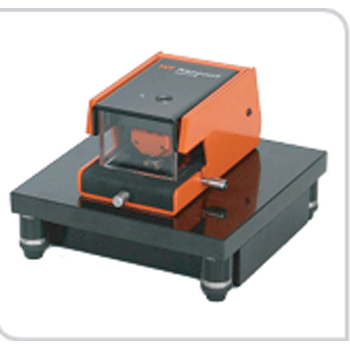 Atomic Force Microscope AFM
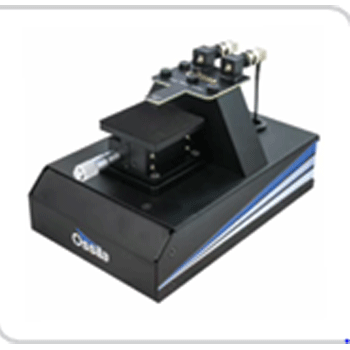 Four-Point Probe
 Polishing & Grainding Machine
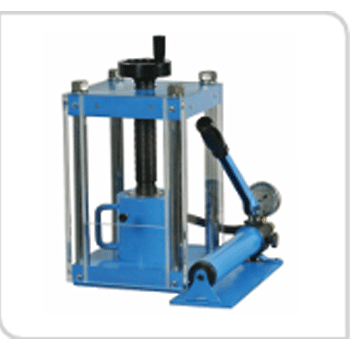 Lab Press With Hydraulic Pump
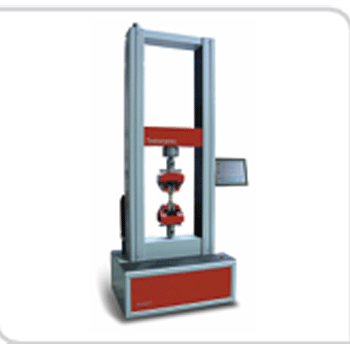 Universal Tensile Tester (UTM)