
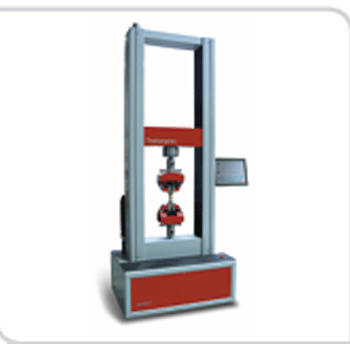
The fundamental principle of a UTM is to apply a controlled force (load) to a test specimen and accurately measure its response, such as deformation (elongation or compression). This data is then used to determine crucial mechanical properties of the material.
A Universal Tensile Tester (UTM), also known as a Universal Testing Machine, Tensile Testing Machine, or Materials Testing Machine, is a highly versatile electromechanical or hydraulic system used to determine the mechanical properties of various materials.
Core Function and Working Principle:
The fundamental principle of a UTM is to apply a controlled force (load) to a test specimen and accurately measure its response, such as deformation (elongation or compression).
Sample Preparation and Clamping: The test specimen is carefully prepared according to specific industry standards (e.g., ASTM, ISO) for its material and the type of test to be conducted.
Force Application: A movable component called the crosshead applies the desired force (tensile, compressive, etc.) to the specimen.
Measurement of Response: As the force is applied, two primary measurements are continuously recorded:
Load Cell: This sensor measures the exact force being exerted on the specimen.
Extensometer (or Displacement Transducer): This device measures the specimen's deformation (e.g., elongation in a tensile test, compression in a compression test) as the force increases.
Data Collection and Analysis: The UTM's control system and integrated software automatically collect and process the real-time data on applied force and corresponding deformation.
Tensile Strength (Ultimate Tensile Strength): The maximum stress a material can withstand before breaking.
Yield Strength (Yield Point): The stress at which the material begins to deform permanently.
Modulus of Elasticity (Young's Modulus): A measure of the material's stiffness or resistance to elastic deformation.
Elongation at Break: The percentage of increase in length of the specimen at the point of fracture.
Flexural Strength/Modulus: For bending tests.
Compressive Strength: For compression tests.
And many other specific properties depending on the test type.
Reporting: The software generates comprehensive reports and can display results in various formats for documentation, analysis, and compliance.
Key Components:
Load Frame: The rigid structure that houses the testing mechanism and withstands the forces applied during testing.
Load Cell: A transducer that accurately measures the applied force.
Crosshead: The movable component that applies the force to the specimen.
Grips/Fixtures: Specialized clamps or holders designed to securely hold different types of specimens for various tests.
Extensometer: A device that precisely measures the change in length or deformation of the specimen during the test.
Control Panel and Software: The interface for setting test parameters, controlling the machine, acquiring data, and analyzing results.
Types of UTMs:
Electromechanical UTMs: Use an electric motor and ball screw drive for precise and controlled force application.
Hydraulic UTMs: Utilize fluid pressure to generate force, making them ideal for high-force applications (e.g., metals, concrete, composites) where extreme loads are required.
Applications:
UTMs are indispensable in a wide range of industries and fields for quality control, research and development, and material characterization:
Materials Science: Characterizing and comparing new and existing materials.
Manufacturing: Ensuring the quality, durability, and safety of products (e.g., metals, plastics, textiles, composites, adhesives).
Aerospace Industry: Testing components for aircraft and spacecraft to ensure they can withstand extreme conditions.
Automotive Industry: Assessing the strength and performance of various vehicle components.
Construction Industry: Evaluating the mechanical properties of building materials like concrete, steel, and rebar.
Medical Device Industry: Testing the strength and durability of implants, prosthetics, and other medical devices.
Textile Industry: Determining tensile strength, elongation, tear resistance, and seam strength of fabrics and fibers.
Packaging Industry: Testing the strength of packaging materials, cartons, and containers.
Research and Development: Investigating new materials, optimizing designs, and understanding material behavior under different conditions. In essence, the Universal Tensile Tester is a critical tool for understanding how materials behave under various mechanical stresses, providing essential data for designing safer, more reliable, and higher-quality products across virtually every industry.
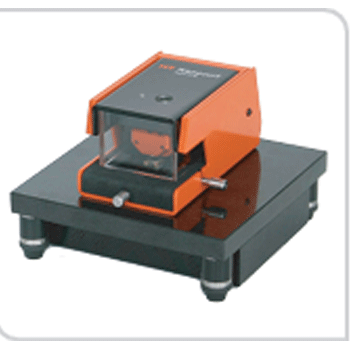 Atomic Force Microscope AFM
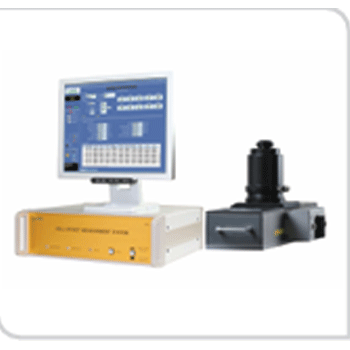 Hall Effect Meserment System
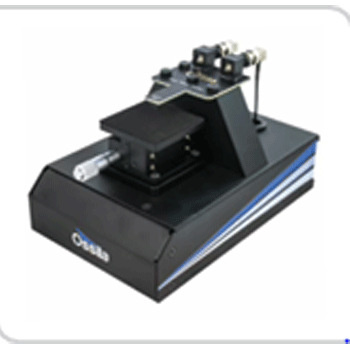 Four-Point Probe
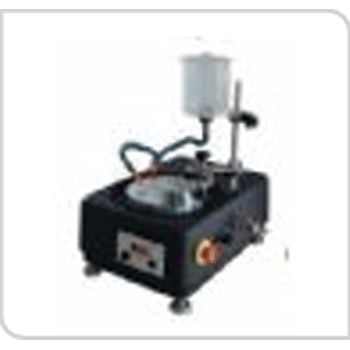 Polishing & Grainding Machine
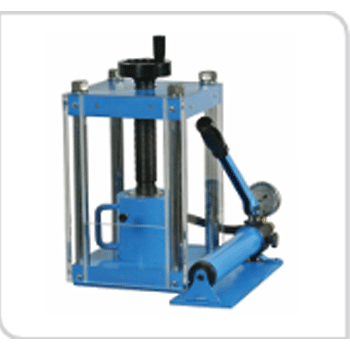 Lab Press With Hydraulic Pump