
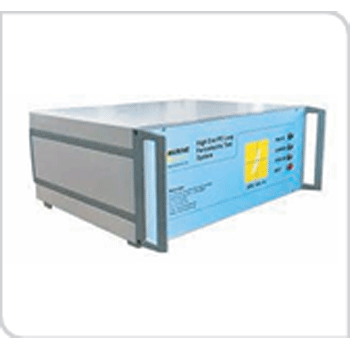
Ferroelectric materials exhibit spontaneous electric polarization that can be reversed by an external electric field. This behavior is analogous to ferromagnetism, where materials retain their magnetization. The P-E hysteresis loop illustrates this:
Applied Electric Field (E): An AC voltage (often triangular or sinusoidal) is applied across the ferroelectric sample, generating an electric field.
Polarization (P): As the electric field changes, the material's internal polarization also changes. This polarization is typically measured by integrating the current flowing through the sample.
Hysteresis: The polarization doesn't simply follow the electric field linearly. Instead, it lags, forming a loop. This hysteresis is a defining characteristic of ferroelectricity, indicating that the material retains some polarization even after the applied field is removed.
Key parameters extracted from the P-E loop include:
Remnant Polarization (): The polarization remaining in the material when the electric field is zero. This signifies the material's ability to store information without power.
Coercive Field (): The electric field required to reduce the polarization to zero. This indicates the field strength needed to switch the material's polarization.
Saturation Polarization (): The maximum polarization that can be induced in the material at high electric field strength.
Hysteresis Width: The overall width of the loop, related to the energy loss during polarization reversal.
A P-E Loop Ferroelectric Test System generally consists of:
Waveform Generator: Generates the applied AC voltage (e.g., triangular, sinusoidal, or custom pulse sequences) to create the electric field across the sample.
High Voltage Amplifier (optional, but common): Amplifies the output of the waveform generator to achieve the high electric fields often required for ferroelectric measurements, especially for thicker samples.
Sample Holder: Provides electrical contacts and often temperature control for the ferroelectric material under test.
Charge/Current Measurement Unit:
Sawyer-Tower Circuit (traditional): Uses a known sense capacitor in series with the ferroelectric sample. The voltage across the sense capacitor is proportional to the charge on the ferroelectric sample, which is then converted to polarization.
Direct Current Measurement (modern): Directly measures the current flowing through the sample using a high-sensitivity current amplifier (e.g., transimpedance amplifier) and then integrates it over time to obtain the charge and thus polarization. This method is often preferred for thin films and leaky materials.
Data Acquisition System (DAQ) / Digitizer: Simultaneously records the applied electric field (voltage) and the measured polarization (charge/current) data.
Computer and Software: Controls the test parameters, acquires and processes data, and displays the P-E hysteresis loop and other derived parameters. Many systems also offer advanced analysis features and the ability to perform various tests.
Temperature Control Unit (optional): For measuring ferroelectric properties at different temperatures (e.g., to determine Curie temperature, or for temperature-dependent studies). This can include cryostats for low temperatures or ovens for high temperatures.
Beyond basic P-E loops, these systems can perform a range of tests to comprehensively characterize ferroelectric and related materials:
Frequency Dependence: Measuring P-E loops at different frequencies to understand dynamic polarization behavior.
Fatigue Measurement: Repeatedly cycling the electric field to observe the degradation of ferroelectric properties over time.
Retention Measurement: Assessing how long the polarization is retained after the field is removed, crucial for memory applications.
Leakage Current (I-V) Measurement: Characterizing the current flow through the material at different voltages, important for understanding resistive losses.
Capacitance-Voltage (C-V) Measurement: Determining the capacitance as a function of applied voltage, which can reveal aspects like depletion regions and domain switching.
PUND (Positive-Up Negative-Down) Measurement: A pulse-based technique to separate switched polarization from non-switched (linear or leakage) components.
Pyroelectric Current Measurement: Measuring the current generated due to temperature changes, indicating pyroelectric properties.
Piezoelectric and Electrostrictive Response: Some advanced systems, often with additional modules like laser interferometers, can also measure the strain (mechanical deformation) as a function of electric field (S-E loop or butterfly loop), which is indicative of piezoelectric and electrostrictive effects.
Multiferroic Measurements: For multiferroic materials, systems may include options to apply magnetic fields simultaneously to study magnetoelectric coupling.
P-E loop ferroelectric test systems are essential tools in research and development for:
Ferroelectric Memories (FeRAM): Characterizing materials for non-volatile memory applications, where remnant polarization is used to store data.
Sensors and Actuators: Developing materials for pressure sensors, ultrasonic devices, micro-electromechanical systems (MEMS), and other transducers that rely on piezoelectric and electrostrictive effects.
Dielectric Materials: Understanding the dielectric properties and losses in various capacitor applications.
Energy Harvesting: Researching materials for pyroelectric and piezoelectric energy harvesters.
Optoelectronics: Investigating ferroelectric materials for optical switches and modulators.
Fundamental Materials Science: Studying domain dynamics, phase transitions (like Curie temperature), and other intrinsic properties of ferroelectric and related functional materials (e.g., multiferroics, relaxor ferroelectrics).
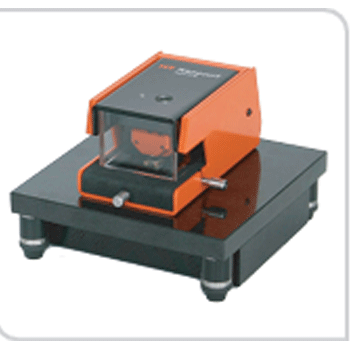 Atomic Force Microscope AFM
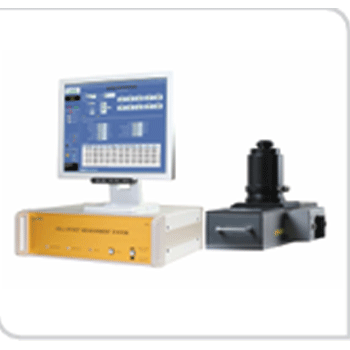 Hall Effect Meserment System
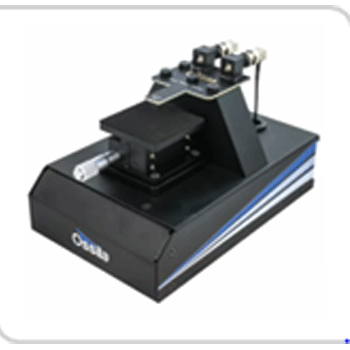 Four-Point Probe
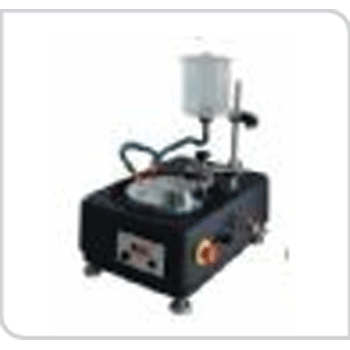 Polishing & Grainding Machine
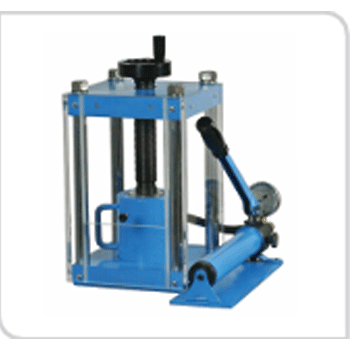 Lab Press With Hydraulic Pump
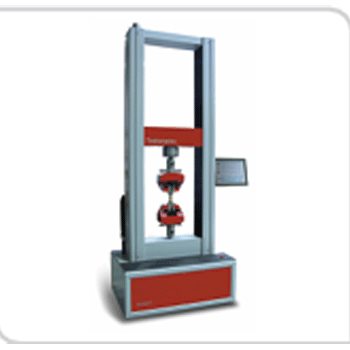 Universal Tensile Tester (UTM)