
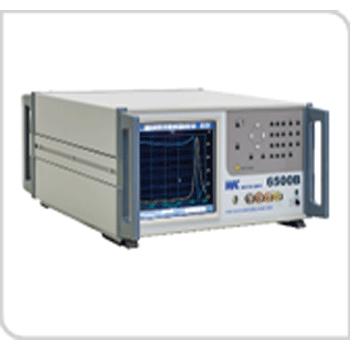
Precision Impedance Analyzer is a highly specialized piece of electronic test equipment used to accurately measure the complex electrical impedance of components, circuits, and materials across a wide range of frequencies. Unlike basic LCR meters, which typically measure at fixed, lower frequencies and provide instantaneous values, a precision impedance analyzer can sweep across a broad frequency spectrum (from microhertz to gigahertz) and display impedance as a function of frequency, often graphically.
Complex Impedance Measurement: It measures impedance (
Wide Frequency Range: Precision impedance analyzers offer a broad frequency range, enabling characterization of components and materials from very low frequencies (μHz) to very high frequencies (GHz).
High Accuracy: They are designed for high accuracy, often with a basic measurement accuracy of 0.05% or better for impedance magnitude and typically in the range of 10 millidegrees for phase angle accuracy.
Multi-Parameter Measurement: Beyond basic impedance, they can derive and display various related parameters, including:
Inductance (L)
Capacitance (C)
Resistance (R)
Reactance (X)
Conductance (G)
Susceptance (B)
Admittance (
Dissipation Factor (
Quality Factor (
Graphical Sweep Capabilities: A significant advantage is their ability to perform frequency sweeps, level sweeps, or DC bias sweeps and display the results graphically (e.g., impedance magnitude and phase vs. frequency).
Test Methods: Common measurement techniques include:
Direct I-V (Current-Voltage) Method: Measures current and voltage directly to calculate impedance.
Auto-Balanced Bridge (ABB) Method: Uses a feedback mechanism to automatically balance a bridge circuit, offering high accuracy over a wide range.
RF I-V Method: An extension of the I-V method for radio frequency measurements.
Test Fixtures and Bias Capabilities: They often come with various test fixtures for different component types (leaded, SMD) and have the ability to apply DC bias voltage or current during measurements, which is essential for characterizing components like varactor diodes or analyzing battery behavior.
Equivalent Circuit Modeling: Many precision impedance analyzers offer functions to fit measured data to equivalent circuit models, allowing for a deeper understanding of the physical properties and parasitic effects of the device under test.
Interfaces: They typically include various interfaces (GPIB, LAN, USB) for remote control, data acquisition, and integration into automated test systems.
How it Works (General Principle):
A precision impedance analyzer works by applying a precisely controlled AC (alternating current) test signal (voltage or current) to the Device Under Test (DUT) at a specific frequency and then simultaneously measuring the resulting voltage across and current through the DUT.
Applications:
Precision impedance analyzers are indispensable tools in various fields:
Electronic Component Characterization:
Capacitors: Measuring capacitance, ESR (Equivalent Series Resistance), ESL (Equivalent Series Inductance), and dissipation factor. Crucial for multilayer ceramic capacitors (MLCCs), functional polymer capacitors, and tantalum capacitors.
Inductors/Coils/Transformers: Characterizing inductance, quality factor, and DCR (DC Resistance).
Resonators (e.g., Piezoelectric Elements): Analyzing resonant frequency and other characteristics.
Diodes and Transistors: Measuring C-V (capacitance-voltage) characteristics of semiconductor devices.
PCBs and Cables: Evaluating signal integrity, characteristic impedance, and dielectric properties of PCB materials.
Material Science:
Dielectric Materials: Characterizing dielectric constant, loss tangent, and conductivity of insulators like biological tissues, foodstuffs, ceramics, and polymers.
Magnetic Materials: Analyzing magnetic permeability and loss.
Semiconductor Materials: Studying electrical properties.
Electrochemical Materials: Applications in battery and supercapacitor research, fuel cells, and corrosion studies (often using Electrochemical Impedance Spectroscopy - EIS).
Research and Development: Designing and optimizing passive components. Understanding the behavior of new materials and their interaction with electrical fields.
Developing sensors.
Quality Control and Manufacturing:
Automated testing of electronic components on production lines.
Ensuring components meet specified parameters.
Other Applications: Biomedical research (e.g., cell membrane studies, tumor diagnosis). Food science (e.g., fruit and vegetable ripeness). Environmental monitoring (e.g., water pollutant detection). In essence, a precision impedance analyzer provides a detailed, high-accuracy picture of how a device or material interacts with AC electrical signals, making it a crucial instrument for design, characterization, and quality assurance in numerous technological and scientific domains.
 Atomic Force Microscope AFM
 Hall Effect Meserment System
 Four-Point Probe
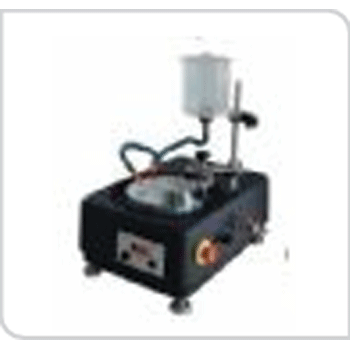 Polishing & Grainding Machine
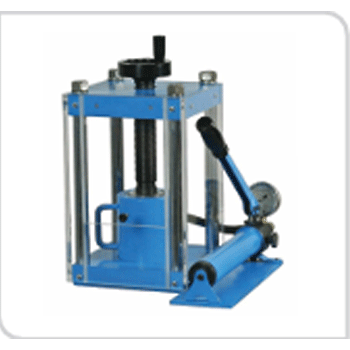 Lab Press With Hydraulic Pump
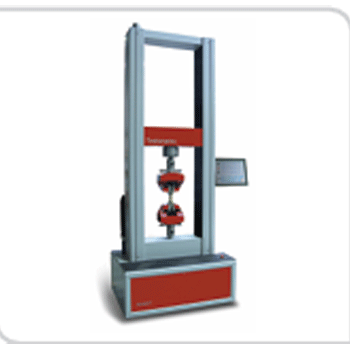 Universal Tensile Tester (UTM)