
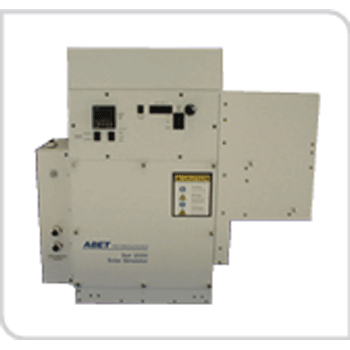
A solar simulator, also known as an artificial sun or sunlight simulator, is a device designed to replicate the illumination characteristics of natural sunlight in a controlled laboratory environment. This allows for the testing of various photosensitive materials, devices, and processes under standardized and repeatable conditions, without the variability of actual sunlight.
A solar simulator, also known as an artificial sun or sunlight simulator, is a device designed to replicate the illumination characteristics of natural sunlight in a controlled laboratory environment.
Key Components of a Solar Simulator:
A solar simulator typically consists of three main parts:
Light Sources (Lamps) and Power Sources: The heart of the simulator, these generate the light.
Optics and Optical Filters: These components are crucial for shaping and filtering the light from the source to achieve the desired spectral distribution, spatial uniformity, and intensity across the test area.
Control Elements: These include power supplies to drive the lamps, shutters to control exposure, and software for precise control over intensity, spectrum, and timing.
How Solar Simulators Work:
Solar simulators aim to match natural sunlight in three critical aspects:
Spectral Match: This refers to how closely the simulator's emitted spectrum matches that of natural sunlight across different wavelength ranges (UV, visible, and infrared).
AM1.5G (Global): Represents sunlight at sea level, passing through 1.5 times the Earth's atmosphere, and includes both direct and diffuse radiation.
AM1.5D (Direct): Similar to AM1.5G but focuses only on the direct component of solar radiation, used for concentrated PV devices.
AM0 (Extraterrestrial): Represents the solar spectrum outside the Earth's atmosphere, used for space applications like satellite solar cells.
Spatial Non-Uniformity of Irradiance: This measures how evenly the light is distributed across the test area.
Temporal Instability of Irradiance: This refers to the stability of the light output over time. The intensity should remain consistent during a measurement or experiment.
Types of Solar Simulators: Solar simulators are broadly categorized by their emission duration:
Continuous (Steady-State) Solar Simulators: These provide continuous illumination and are typically used for low-intensity testing and smaller areas, often in academic and commercial labs.
Flashed (Pulsed) Solar Simulators: These use flash tubes to deliver short bursts of very high-intensity light (up to several thousand suns) lasting milliseconds.
Classification and Standards:
Solar simulators are classified according to international standards (e.g., IEC 60904-9, ASTM E927, JIS C 8904) based on their performance in spectral match, spatial non-uniformity, and temporal instability.
Applications of Solar Simulators:
Solar simulators are indispensable tools across a wide range of scientific and industrial fields due to their ability to provide a controllable and repeatable sunlight environment:
Photovoltaic (Solar Cell) Testing: This is one of the primary applications, used to determine the efficiency, power output, and I-V (current-voltage) characteristics of solar cells and modules.
Material Testing and Weathering: Evaluating the degradation, aging, and performance of materials (plastics, paints, textiles, building materials) under simulated sunlight exposure.
Photochemistry and Photobiology: Researching light-driven reactions, such as water splitting, artificial photosynthesis, crude-oil degradation, and studying the effects of light on biological processes (e.g., photosynthesis, skin cancer research, sunscreen efficacy).
Aerospace and Space Applications: Testing solar cells and materials for satellites, CubeSats, and other spacecraft under AM0 conditions.
Cosmetics and Dermatology: Assessing the sun protection factor (SPF) of sunscreens and studying the effects of UV radiation on skin.
Smart Glass and Wearables: Testing the performance of smart glass that changes properties with light, and the durability of wearable devices exposed to sunlight.
LiDAR Sensors and Machine Vision: Simulating real-world lighting conditions for sensors used in mapping and autonomous systems.
 Atomic Force Microscope AFM
 Hall Effect Meserment System
 Four-Point Probe
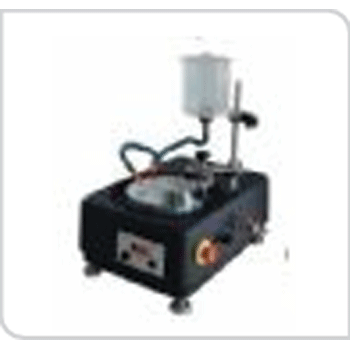 Polishing & Grainding Machine
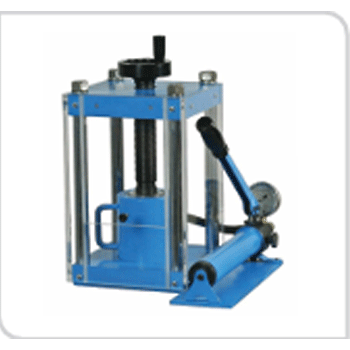 Lab Press With Hydraulic Pump
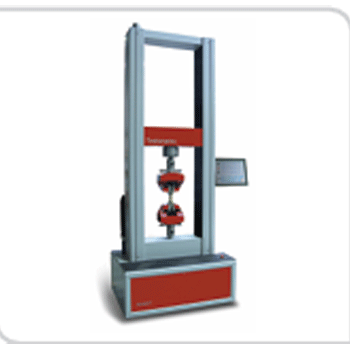 Universal Tensile Tester (UTM)