
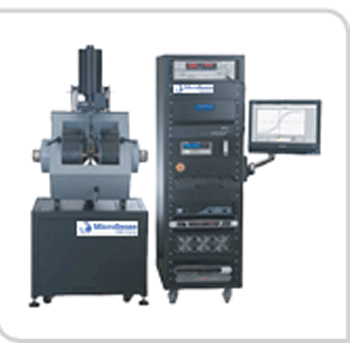
A VSM measures the magnetic moment of a sample as a function of an applied magnetic field, temperature, or angle. It's particularly useful for determining various magnetic parameters like:
Hysteresis loops: These plots of magnetization (M) versus applied magnetic field (H) provide crucial information about a material's magnetic response, including:
Saturation magnetization (
Remanence (
Coercivity (
Initial magnetization curves: Shows how a material magnetizes from a demagnetized state.
Temperature-dependent magnetization: Helps determine critical temperatures like the Curie temperature (TC) or Néel temperature.
Magnetic anisotropy: The dependence of magnetic properties on the direction of the applied magnetic field.
VSMs are highly sensitive, capable of detecting magnetic moments as small as
The operation of a VSM is based on Faraday's Law of Induction. The core idea is that a changing magnetic field induces an electric current in a coil.
Here's how it works:
Applied Magnetic Field: The sample is placed in a uniform, external magnetic field generated by an electromagnet.
Sample Vibration: The sample is then mechanically vibrated sinusoidally (typically up and down) at a fixed frequency (e.g., 85 Hz).
Induced Signal: As the magnetized sample vibrates, its magnetic dipole moment creates a fluctuating magnetic field around it.
Signal Detection and Measurement: The induced signal in the pick-up coils is proportional to the magnetic moment of the sample, the vibration amplitude, and the vibration frequency.
Data Acquisition: A computer system controls the applied magnetic field, manages the vibration, and records the induced signal. By sweeping the magnetic field over a range and measuring the corresponding induced signal, a magnetization curve (e.g., a hysteresis loop) is generated.
A typical VSM system consists of several key components:
Electromagnet and Power Supply: Generates the uniform, adjustable external magnetic field. High-field VSMs often use actively cooled electromagnets.
Vibration Exciter and Sample Holder: The vibration exciter (often a motor or piezoelectric device) provides the sinusoidal motion to the sample.
Sensor (Pick-up) Coils: Stationary coils strategically placed around the sample to detect the changing magnetic flux and generate the induced signal.
Amplifier and Lock-in Amplifier: Amplifies the weak signal from the sensor coils and filters out noise, allowing for precise measurement of the magnetic moment.
Control Chassis and Computer Interface: Manages the system's operation, controls the electromagnet and vibration, and acquires and processes the data.
Temperature Control Unit (Optional but common): Allows measurements to be performed over a wide temperature range (e.g., cryogenic temperatures to high temperatures) using furnaces or cryostats.
Hall Probe (Optional): Used to precisely measure the strength of the applied magnetic field.
VSMs are widely used in both academic research and industrial settings for characterizing various magnetic materials, including:
Magnetic Powders and Nanoparticles: Essential for understanding the magnetic behavior of nanomaterials for applications in biomedicine (e.g., drug delivery, MRI contrast agents), data storage, and spintronics.
Thin Films and Multilayers: Characterizing magnetic properties of thin films used in magnetic recording, sensors, and magnetic random-access memory (MRAM).
Bulk Magnetic Materials: Studying the magnetic properties of permanent magnets, soft magnetic materials, and superconducting materials for diverse engineering applications.
Anisotropic Materials: Investigating how magnetic properties vary with crystal orientation.
Geophysics and Environmental Studies: Analyzing magnetic properties of rocks and sediments to understand Earth's magnetic field history and geological events.
Biomagnetism: Studying magnetic biological systems and developing new magnetic biosensors.
In summary, the VSM is a powerful and versatile tool for understanding the fundamental magnetic properties of a wide range of materials, enabling advancements in various scientific and technological fields.
 Atomic Force Microscope AFM
 Hall Effect Meserment System
 Four-Point Probe
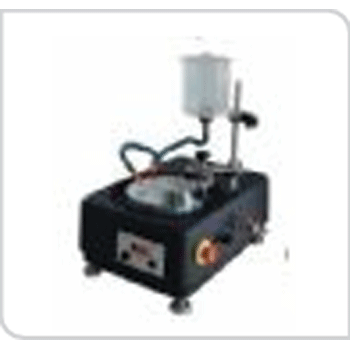 Polishing & Grainding Machine
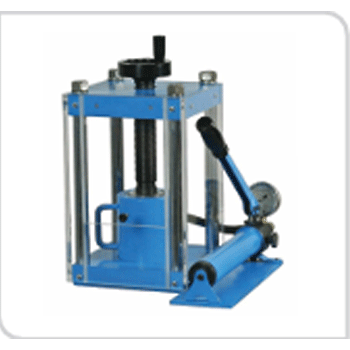 Lab Press With Hydraulic Pump
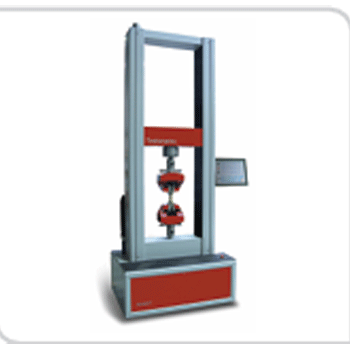 Universal Tensile Tester (UTM)